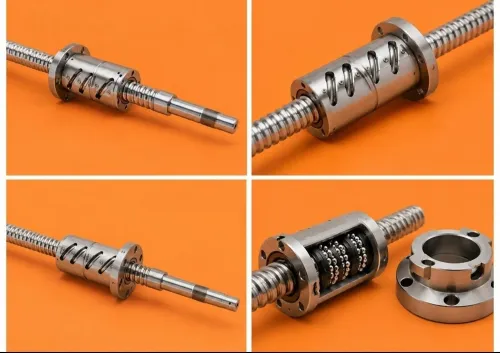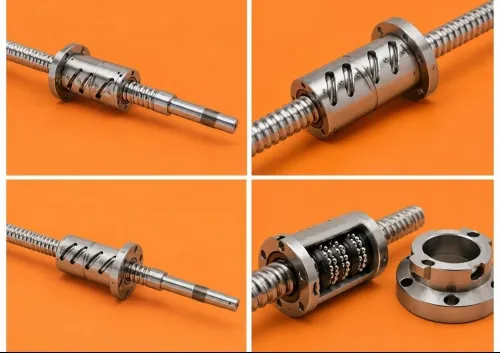

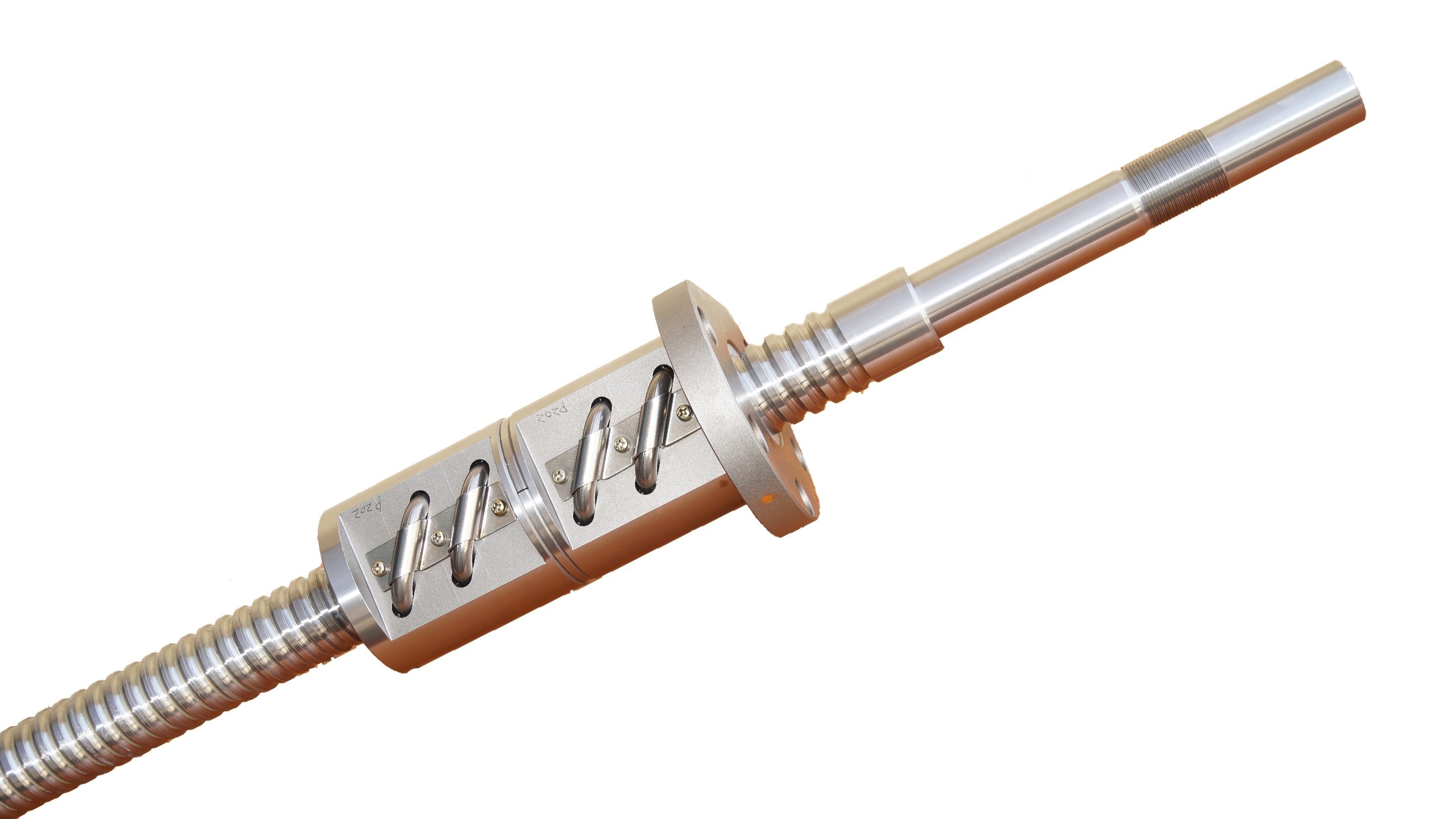
A double nut screw is not made by placing two catalogue nuts on one shaft: the manufacturer must create, measure, and preserve a controlled preload across two matched ball circuits. By following the production sequence, you can judge whether a proposed assembly suits your load, speed, accuracy, contamination, and service requirements, and identify the records that prove it was built correctly.
Key takeaways
- Use opposed nut preload to remove axial play without excessive running torque.
- Control raceway geometry, ball lot, spacer size, and coupling adjustment during production.
- Match nut pairs after machining to preserve the intended preload across the assembly.
- Request lead-error, preload, runout, hardness, and dimensional inspection records.
How two nuts remove play without creating excessive drag
A double nut removes axial play by forcing two matched nut circuits to oppose each other on the same screw. During double nut ball screw production, the manufacturer selects a controlled ball lot, finishes the Gothic-arch raceways, and establishes interference with either a precision spacer or an adjustable coupling.
A spacer is finish-ground or selectively matched; its nominal thickness alone cannot guarantee preload because ball diameter and raceway tolerances also contribute.
That preload keeps the balls in continuous contact with both flanks of the screw raceway. Axial backlash falls sharply, and axial rigidity rises, so commanded motion produces less lost position under load.
The benefit disappears if the two nuts have mismatched contact angles or raceway errors: one circuit carries more load, creating noise and torque variation.
More preload is not automatically better. It increases running torque, friction, and heat, while reducing mechanical efficiency and raising the lubrication demand. Excessive interference can overload the balls and raceways, shorten service life, and cause motor overload during acceleration.
The manufacturer therefore sets preload against speed, duty cycle, load, and cooling capacity rather than choosing the highest value.
Assembly also requires controlled cleanliness. Chips or dust in the return path can indent the raceways, causing cyclic torque and premature wear. A finished pair should run smoothly through its travel, with measured preload and running torque recorded for acceptance.
From bar stock to a controlled screw and nut geometry
The shaft is not cut into a finished raceway: in double nut rolled ball screw manufacturing, hardened dies cold-form the helical track into prepared bar stock. The nuts receive complementary internal raceways, while ball size, return geometry, and controlled spacing establish the working fit.
1. Select alloy steel with consistent hardness and cleanliness, then cut bar stock to length. Remove scale, centre-drill or machine the ends, and correct straightness before rolling.
2. Roll the external raceway between hardened dies. Die accuracy, alignment, material condition, and forming pressure control lead, groove form, pitch diameter, and surface integrity; rolled construction is not an accuracy grade by itself.
3. Machine each nut body, bore, mounting faces, internal raceway, and retaining features. Finish the ball tracks and deburr every edge that contacts a ball.
4. Sort balls by measured diameter or use a matched lot. A small diameter change alters contact interference, preload, friction, and torque in both nut circuits.
5. Fit return tubes, end caps, or deflectors to create a continuous circulation path. Misalignment or a burr causes recirculation noise, torque spikes, ball damage, and early wear.
6. Assemble the two nuts as a controlled set, using a precision spacer or adjustable coupling to establish their specified relationship.
7. Inspect lead, runout, torque, and smooth travel with calibrated equipment. Record screw temperature and measurement setup, because thermal growth during a long-screw test can appear as geometric lead error.
Why matching the two nuts matters after machining
A spacer dimension alone does not prove that two nuts are matched. In double nut ball screw production, the manufacturer matches ball diameter, raceway geometry, contact angle, and spacer condition as an assembled system; a small mismatch can leave one circuit carrying most of the load.
1. Select balls from a controlled diameter lot, then pair them with nuts whose Gothic-arch raceways have compatible form and contact angle. Sort out damaged balls and inspect the tracks for burrs, dents, or brinelling.
2. Finish-grind or selectively match the spacer for the required axial interference. The spacer sets the relationship between the nuts, but ball and raceway tolerances determine the actual preload, so measure the assembled pair rather than accepting a nominal spacer size.
3. Assemble the nuts in a clean area and fit the correct return tubes, end caps, or deflectors. A burr or misaligned return path interrupts circulation, damages balls, and creates cyclic torque spikes.
4. Protect the raceways and return path from chips, dust, and handling damage. Even a small abrasive particle can mark a preloaded track and produce noise that a later adjustment cannot remove.
5. Run in the assembled screw with the specified lubricant before checking torque and accuracy. This redistributes lubricant and settles minor contact conditions; it cannot fix a wrong ball set, spacer, return component, or damaged raceway.
Record preload, running torque, and torque variation after run-in. Stable readings show that both circuits are sharing load instead of forcing one nut to carry the assembly.
How the manufacturer sizes the assembly for the machine axis
Axial load is the starting number, but peak acceleration and overturning moment often set the diameter. A precision ballscrew manufacturer sizes a double nut screw for process loads, not just the steady cutting or positioning load.
- Load and moment determine screw diameter, ball diameter, nut length, and required static safety factor; a slender shaft can deflect even when its nuts remain stiff.
- Speed and lead determine the screw’s rotational speed and critical-speed margin; a larger lead reduces revolutions per minute but raises linear thrust demand.
- Acceleration sets peak thrust and preload demand; excessive preload adds torque and heat instead of useful stiffness.
- Travel sets the threaded length, shaft-end geometry, and support span; long travel can require a larger diameter or a rotating-nut arrangement to avoid whip.
- Duty cycle sets thermal limits; frequent rapid strokes favour lower preload, adequate lubrication, and heat paths through the housing.
- Accuracy determines the screw type and grade; a rolled screw can suit many axes, but “rolled” alone does not specify lead accuracy, repeatability, or runout.
- Mounting conditions determine the support arrangement: fixed-supported limits one end, fixed-fixed raises axial stiffness, and bearing stiffness becomes part of the axis error budget.
Ball size and nut length are balanced against load capacity, speed, available space, and return-path reliability. The manufacturer then selects fixed or adjustable preload to meet stiffness without sacrificing efficiency or service life. A double nut cannot correct a flexible housing, weak bearings, or poor alignment.
Which inspection records prove the finished screw is fit for service
Approve the screw against a drawing and inspection report, not the phrase “precision grade.” The report must identify the accuracy class, reference length, measurement method, screw temperature, and calibrated equipment used. A rolled screw’s accuracy depends on die condition, alignment, material, compensation, and straightening; “rolled” is not an accuracy grade.
Request these records:
- Lead-accuracy plot, with measured error over the specified reference length and thermal-growth correction.
- Repeatability results, reported separately from lead accuracy.
- Axial and radial runout readings, including datum, measurement locations, and limits.
- Starting and running torque results at stated speed, lubricant, temperature, and preload.
- Final preload value for the assembled pair; a nominal spacer thickness is not proof of preload.
- Ball, spacer, return-tube or deflector traceability, plus assembly and run-in records.
- Calibration certificates for the rotary, linear, torque, and runout instruments.
- Material certificate, heat-treatment record, dimensional drawing, and nonconformance disposition.
| Evidence | What it proves | What a missing record can hide |
|---|---|---|
| Lead plot | Positioning accuracy over length | Thermal or setup error |
| Runout report | Straightness and rotation quality | Coupling vibration and uneven load |
| Torque and preload report | Drag and axial interference | Heat, noise, or premature wear |
| Return-path inspection | Smooth closed ball circulation | Burrs, ball damage, and torque spikes |
During the precision ball screw manufacturing process, Balaji Engineering Works can add value by agreeing the acceptance format before production, including test speed, temperature, reference length, preload target, and rejection limits. That prevents a conforming-looking report from measuring the wrong condition.
Related product
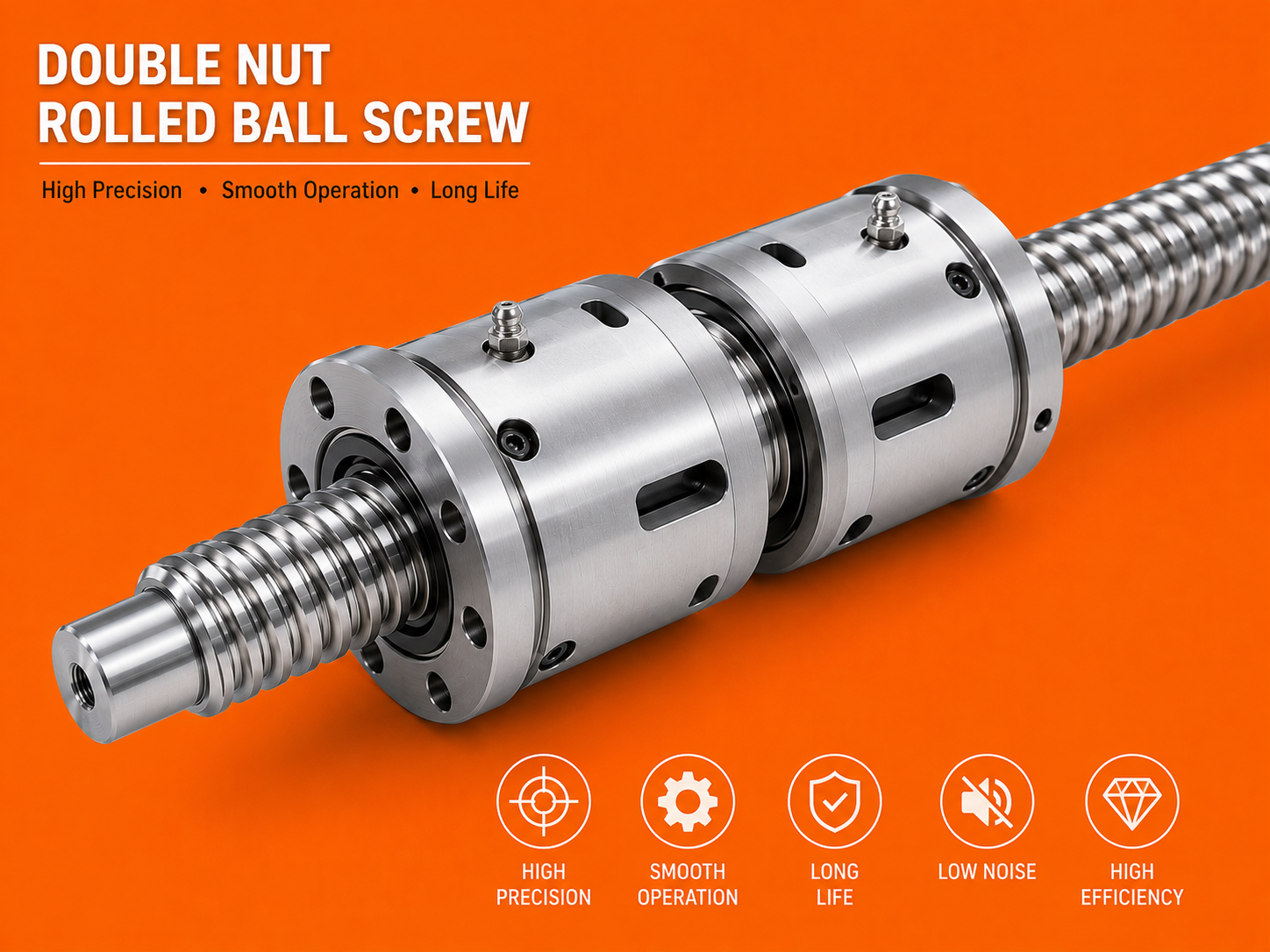 | Precision Ballscrews Balaji Engineering Works offers high-performance Double Nut Rolled Ball Screws in Pune, designed for applications requiring reduced backlash,... View product → |
Frequently asked questions
How do two nuts remove play without creating excessive drag?
The nuts oppose each other on the screw, creating controlled preload that removes axial play. The manufacturer limits interference so preload does not produce excessive friction or heat.
Why does matching the two nuts matter after machining?
Machining changes the relationship between each nut and its raceway. Matching the pair after machining helps preserve the specified preload and prevents uneven load sharing.
How is a double nut ballscrew sized for a machine axis?
The manufacturer uses axis load, travel, speed, acceleration, duty cycle, accuracy, stiffness, and mounting conditions to select screw diameter, lead, nut arrangement, and preload.
Which inspection records show that a finished double nut ballscrew is fit for service?
Request records for lead error, axial runout, radial runout, preload or torque, raceway and ball condition, dimensions, hardness, and final assembly identification.