
A replacement quotation can hide a major mismatch when “ball leading screw” and “ball screw” are used interchangeably. By the end, you will be able to identify the existing assembly, compare rolled and ground options, match the screw to the drive, diagnose the actual source of backlash, and specify replacement parts without relying on diameter and length alone.
Key takeaways
- Confirm whether “ball leading screw” means a recirculating ball screw or sliding lead screw.
- Match diameter, lead, nut geometry, preload, and critical speed before ordering replacement parts.
- Check couplings, bearings, alignment, and load before blaming the screw for backlash.
- Demand dimensional drawings, material details, inspection results, and traceable replacement documentation.
Are a ball leading screw and a ball screw the same component?
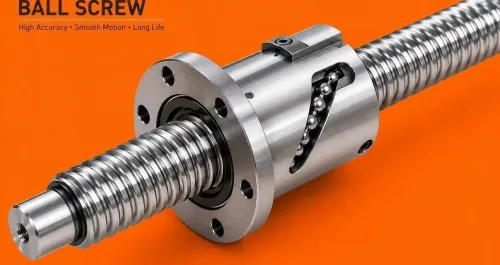
“Ball leading screw” and “ball screw” are not reliably the same product. “Ball leading screw” is not a consistently standardised catalogue term: one supplier may mean a conventional recirculating-ball screw, while another may mean a sliding Acme or trapezoidal lead screw fitted with a ball-bearing nut.
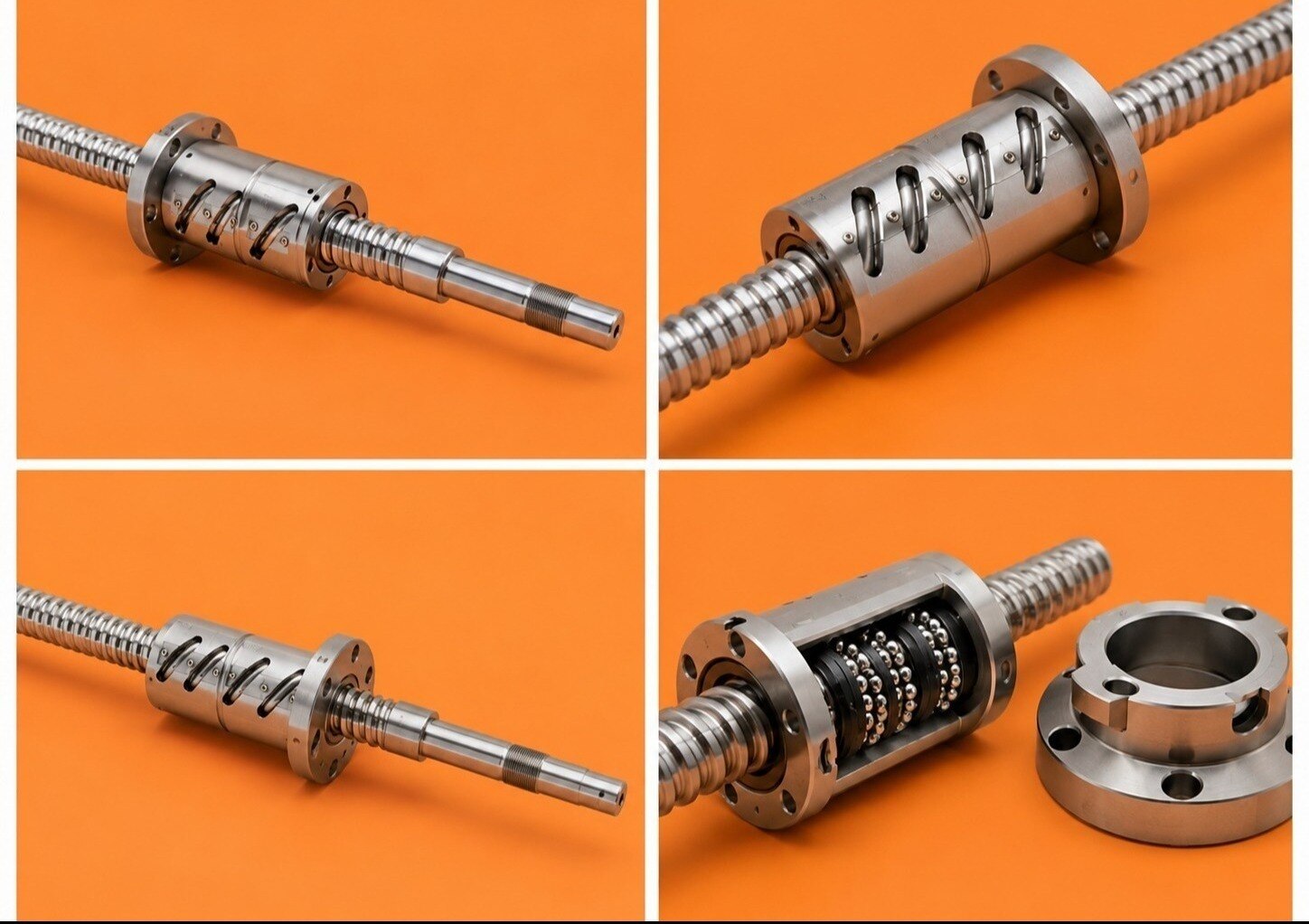
Ask whether the nut contains recirculating balls running between the screw and nut raceways.
| Feature | Recirculating ball screw | Acme or trapezoidal lead screw |
|---|---|---|
| Friction and efficiency | Low friction; commonly about 80–95%, depending on conditions | Sliding friction; roughly 20–70%, depending on materials, lead and lubrication |
| Back-drivability | Often back-drivable, especially with a large lead | More resistant to back-driving; some designs are self-locking |
| Accuracy and service life | Low backlash and high duty-cycle capability when correctly preloaded | Greater wear and backlash as the nut wears |
| Contamination and alignment | Needs clean assembly, suitable seals, lubrication and accurate alignment | More tolerant of contamination and alignment error |
| Noise and cost | Ball returns can add noise; purchase and maintenance cost are higher | Often quieter, simpler and cheaper at low speed |
Never assume a ball screw will hold a vertical load. Provide a motor brake, counterbalance or another load-holding device.
Before requesting a quotation, send this question to a ball leading screw supplier in Bengaluru:
- Does “ball leading screw” mean a recirculating-ball screw or a sliding lead screw with a ball-bearing nut, and what are the rated efficiency, backlash, preload, accuracy, lubrication and vertical-load safety requirements?
How do rolled and ground screws compare in a real machine?
Rolled screws suit normal automation, pick-and-place axes, and cost-sensitive CNC duty when adequate lead accuracy matters. Precision-ground screws suit machine tools and interpolated CNC motion when pitch error, thermal behaviour, and tight positioning control justify the added cost. For a ball leading screw comparison, do not treat “precision” as one specification.
| Route | Practical difference | Best fit |
|---|---|---|
| Rolled | Formed by pressing the thread; lower cost, high production speed, good efficiency, and useful contamination tolerance | General automation, pick-and-place, moderate-duty CNC |
| Ground | Thread ground after heat treatment; tighter pitch control and smoother error mapping, but higher cost and greater sensitivity to contamination | Machine tools, interpolation, precision CNC axes |
| ISO 3408 class 1, 3, 5, 7, 10 | Defined accuracy classes; the class alone does not state every acceptance condition | Compare only with the full standard and test data |
| Catalogue C5 or C7 | Supplier-specific shorthand unless the governing standard is stated | Demand the standard before comparing quotations |
| Preloaded assembly | Reduces axial play and improves rigidity, but increases torque, heat, and preload-related wear | Precision positioning when correctly selected |
| Sealed, lubricated assembly | Protects raceways and controls friction; seals add drag and heat | Dirty machinery or long service intervals |
Ask for the governing standard, measured length, error definition, and acceptance method before comparing ISO 3408 classes with C5 or C7. Accuracy is not repeatability: a screw can repeat while carrying cumulative pitch error, and neither grade fixes backlash, flexible supports, or structural error.
Efficiency, speed, noise, and service life also depend on lead, load, preload, seals, lubrication, alignment, and contamination. Thermal growth from preload, seals, bearings, and motor duty can dominate a long axis, so measure the assembled machine and consider cooling or temperature compensation.
How do you identify a replacement and match it to the motor?
A removed assembly becomes a usable replacement specification only after you record geometry, performance, and installation conditions. Nominal diameter and overall length alone can produce a costly mismatch.
- Measure and record nominal screw diameter, lead, pitch, overall length, effective threaded length or stroke, nut body length, flange and mounting-hole pattern, shaft-end geometry, right- or left-hand thread, seal arrangement, ball-return style, accuracy class, preload or axial play, lubrication, and mounting orientation.
- Match the screw and motor to axial load, acceleration, duty cycle, critical speed, unsupported length, end fixing, buckling risk, nut speed, thermal growth, and a stated numerical safety margin. A same-diameter screw with a different lead changes linear speed, thrust, motor torque, and positioning behaviour.
Pitch is the axial distance between adjacent thread forms; lead is the axial travel in one revolution. They are equal on a single-start screw, while a multi-start screw has a lead greater than its pitch.
Ask a ball screw manufacturer to state positioning accuracy separately from repeatability, backlash, axial play, and CNC compensation. Critical speed depends on shaft diameter, support arrangement, balance, nut design, and stroke, so identical dimensions do not guarantee identical limits.
Do not fit an unmatched nut or loose balls to the existing screw. Ball screw replacement parts require matched raceway geometry, ball diameter, conformity, preload, and contamination control; the wrong combination causes drag, seizure, lost motion, or premature wear.
How can you prove the screw is the source of backlash?
Do not order a new screw until reversal testing isolates the lost motion. A dial-indicator reading that changes when the coupling, bearings, or housing moves is not proof of nut backlash.
1. Lock the coupling to prevent rotation, place the indicator against the screw or nut, and apply a controlled axial load in one direction. Reverse the load without rotating the screw and record the indicator change. Repeat at several positions along the stroke.
2. Remove the coupling and turn the screw by hand through its full travel. Mark rough spots, torque variation, tight sections, and sudden drag. Verify bearing endplay, bearing preload, housing tightness, and keyway or clamp security before blaming the nut.
3. Inspect the screw and nut raceways for pitting, brinelling, scoring, and fretting. Examine ball returns for cracks or obstruction, then check wipers and seals for cuts, distortion, or embedded debris.
4. Inspect both end journals for fretting, impact marks, bending, or poor fits. Check guideway clearance and measure parallelism between the screw and guideways; misalignment can create position-dependent backlash and torque peaks.
5. Sample the lubricant. Metal particles, hardened grease, water, or abrasive contamination identify a failed protection or lubrication condition, not merely a worn component.
Replace the screw-and-nut assembly when axial play remains after these checks and follows the nut through repeated positions. Specify matched ball screw replacement parts; an unmatched nut or loose balls can seize the assembly. Contamination, excessive preload, impact damage, or misalignment will quickly damage a replacement.
What should you demand from a Bengaluru replacement supplier?
Geographic proximity does not prove interchangeability. Send a ball screw manufacturer near bengaluru the original drawing, photographs of both shaft ends and nut returns, measured dimensions, machine axis and stroke, motor data, CNC compensation values, duty cycle, load direction, and backlash-inspection evidence.
Ask the quotation to state:
- Complete screw-and-nut assembly, or a matched nut replacement
- Lead, handedness, effective stroke, nut dimensions, flange and mounting-hole pattern
- Material, heat-treatment details, shaft-end geometry, and ball-return arrangement
- Lead-error data, accuracy standard, preload or axial play, seal type, and lubrication
- Critical-speed calculation, inspection report, warranty terms, and mounting confirmation
A ball leading screw supplier in bengaluru should also separate screw accuracy from axis repeatability. A C5 or ISO 3408 Class 5 label means little without the measured length, error definition, and acceptance method; request the actual report and CNC compensation basis.
| Quote type | What it gives you | Main risk |
|---|---|---|
| Lowest-price source | A nominally matching part | Hidden lead error, preload, or mounting mismatch |
| Local reviewed source | Measurement, inspection, and application checks | Higher purchase price |
| Matched replacement | Screw and nut selected as a pair | Requires complete assembly data |
Local dimensional support matters when shaft ends, nut returns, or mounting faces are uncertain. Balaji Engineering Works is one Bengaluru source to discuss a drawing-led replacement. Compare verified compatibility, not the generic label “ball screw replacement parts.”
Frequently asked questions
Are a ball leading screw and a ball screw the same component?
Not necessarily. “Ball leading screw” is not a consistently standardised catalogue term; confirm whether the supplier means a recirculating-ball screw or a sliding Acme or trapezoidal screw with a ball-bearing nut.
How do rolled and ground screws compare in a real machine?
Rolled screws suit many cost-sensitive applications and provide practical accuracy, while ground screws offer tighter lead accuracy and finer control for demanding positioning. Compare required accuracy, preload, speed, load, noise, and service life.
How do you identify a replacement and match it to the motor?
Record screw diameter, lead, travel length, nut dimensions, mounting arrangement, preload, end machining, and hand. Then check motor torque, speed, critical speed, acceleration, and coupling bore against the replacement.
How can you prove the screw is the source of backlash?
Measure reversal error with a dial indicator or linear scale, then inspect the nut, fixed and floating bearings, coupling, thrust shoulder, and axis alignment. Isolate each part before replacing the screw.
What should you demand from a Bengaluru replacement supplier?
Request a dimensioned drawing, lead and diameter, nut type, preload class, material and heat-treatment details, end-machining confirmation, inspection results, batch traceability, and a fitment warranty in writing.