
A ball screw converts motor rotation into controlled linear travel, but choosing one involves more than matching a screw diameter to a motor. By the end, you will know how the mechanism works, when it beats other drive types, which performance figures to request, and how to check the complete machine fit.
Key takeaways
- Use ball screws for precise, efficient linear motion under controlled loads.
- Calculate axial load, critical speed, stiffness, accuracy, and required service life.
- Choose ground screws for high accuracy and rolled screws for lower-cost applications.
- Match screw lead, nut preload, mounting, and lubrication to your CNC axis.
How an industrial ball screw converts rotation into linear travel
One revolution of the screw shaft can move a machine axis a precise, defined distance. These industrial ball screw basics explain how industrial ball screws work: a rotating shaft drives a nut through rolling contact instead of sliding thread contact.
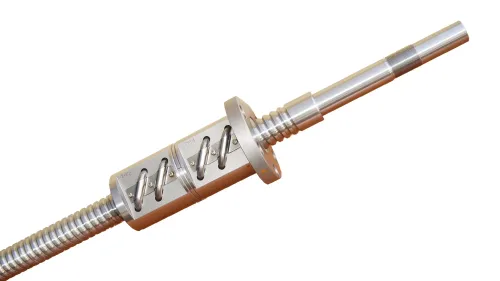
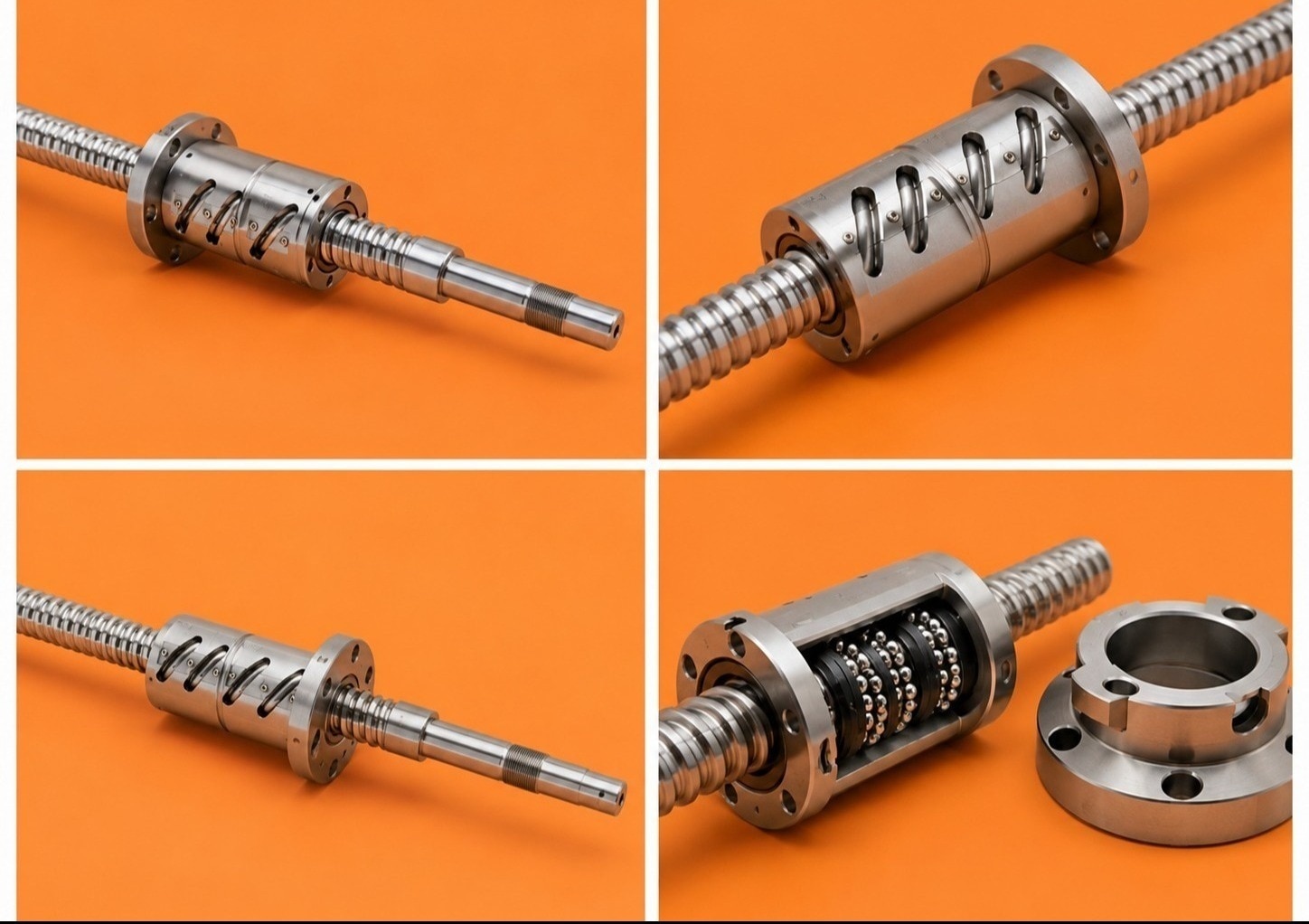
- Screw shaft: the threaded, helical member connected to the motor or coupling.
- Ball nut: the travelling housing whose matching grooves carry the load.
- Hardened recirculating balls: steel balls that roll between the shaft and nut grooves.
- Return path: an internal or external channel that sends balls back to the start of the circuit.
- End supports: bearing arrangements that locate the shaft, control runout, and carry radial and axial forces.
As the shaft turns, its helical grooves push the balls along matching grooves in the nut. The balls roll around the loaded contact zone, enter the return path, and circulate continuously. Rolling contact sharply reduces sliding friction, starting torque, and heat compared with a plain lead screw.
Pitch is the axial distance between adjacent thread turns. Lead is the nut’s travel per revolution: on a single-start screw, lead equals pitch; on a multi-start screw, lead equals pitch multiplied by the number of starts.
Mechanical efficiency is roughly 85–95%, depending on lead angle, preload, seals, lubrication, load, and speed. That efficiency also permits backdriving. Preload removes unwanted axial play and raises stiffness, but increases friction and heat. A vertical axis therefore needs a brake, counterbalance, or load-holding system; do not rely on the screw to hold the load.
When a ball screw is the right drive—and when it is not
Choose a ball screw when an axis needs repeatable positioning, substantial axial thrust, and moderate-to-high duty-cycle motion. Its roughly 85–95% thrust efficiency reduces motor power, but also makes backdriving easy.
Industrial ball screw basics make the trade-off clear:
| Drive | Thrust and positioning | Speed and travel | Stiffness, shock, contamination | Cost and maintenance |
|---|---|---|---|---|
| Ball screw | High efficiency and accurate repeatability | Moderate-to-high speed; medium travel | High stiffness; poor tolerance of shock and abrasive debris | Moderate cost; needs lubrication, seals, and alignment |
| Lead screw | Lower efficiency; suitable for simpler positioning or self-locking motion | Lower speed; short-to-medium travel | Lower stiffness; tolerates shock better | Lower cost; simpler maintenance |
| Belt drive | Low thrust stiffness; adequate positioning for lighter loads | Very fast, long travel | Absorbs shock; debris-tolerant when enclosed | Low cost; belt tension and wear checks |
| Rack-and-pinion | Good thrust and repeatability | Long axes; high speed | Stiff over long travel; exposed teeth dislike contamination | Moderate cost; lubrication and backlash adjustment |
| Linear motor | Direct thrust and excellent positioning | Highest acceleration; no screw speed limit | No mechanical screw stiffness; vulnerable to heat and contamination | High cost; complex controls and cooling |
| Roller screw | Highest load capacity and stiffness | High duty cycle; shorter practical travel | Better for extreme loads, but still needs cleanliness | Highest cost; specialised maintenance |
Use a lead screw for simple or self-locking motion. Select a belt for long, fast travel, a rack-and-pinion for long axes, and a linear motor for extreme acceleration. Severe shock, abrasive contamination, extreme load, or uncontrolled vertical backdriving favours a roller screw, protected cylinder, or load-holding system instead.
How to size a ball screw for load, speed, accuracy, and service life
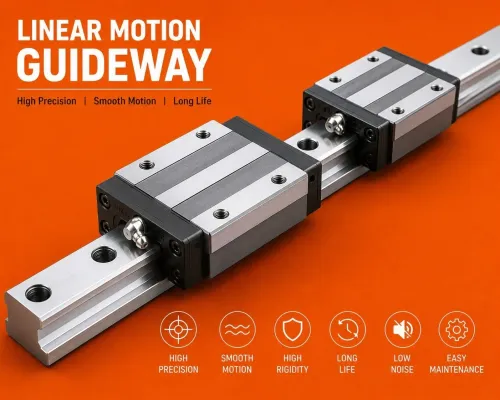
Calculate the loads before choosing diameter or lead: axial thrust, radial load, moment load, acceleration force, travel, duty cycle, and mounting orientation. Guides must carry radial and moment loads; forcing them through the nut causes binding and early wear.
For a ball screw for machine tools in pune, also specify positioning accuracy, repeatability, axial stiffness, environment, lubrication, and expected life.
- Convert cutting, clamping, gravity, and acceleration forces into an equivalent axial load. On a vertical axis, add gravity to process and acceleration loads; reversing acceleration changes the sign, not the need to include it.
- For variable duty, use Pe = [(P1³N1 + P2³N2 + …)/(N1 + N2 + …)]^(1/3), weighting each load by revolutions or operating time.
- Check lead against required linear speed, then calculate maximum rpm. Compare it with critical speed from unsupported length, shaft diameter, end-support arrangement, straightness, and the manufacturer’s safety margin.
- Allow for lower limits from ball recirculation speed, seals, lubrication, temperature, and transmitted torque; the motor’s rpm rating is not the screw’s speed rating.
- Verify full stroke, lead accuracy, repeatability, backlash, preload, axial stiffness, contamination, coolant, humidity, sealing, and lubricant access.
For constant load, basic life is L10 = (C/P)^3 × 10^6 revolutions, where C is dynamic load rating and P is equivalent axial load.
| Selection figure | Why it matters | Failure if ignored |
|---|---|---|
| Unsupported length | Sets critical speed and bending risk | Whip, vibration, or resonance |
| Lead | Sets speed, thrust, and motor torque | Overheating or inadequate force |
| Duty-cycle load | Sets equivalent load and L10 life | Premature raceway fatigue |
What rolled, ground, single-nut, and double-nut specifications really mean
Rolled and ground describe how the screw grooves are made, not an automatic performance grade. Rolled screws cost less and usually ship with less manufacturing effort; ground screws offer finer surface finish and tighter achievable lead accuracy, making them common on high-accuracy CNC axes.
A rolled screw can still meet a specified grade, while a ground screw can fail poor installation or inspection.
| Construction | Accuracy and behaviour | Cost, delivery, and use |
|---|---|---|
| Rolled, single nut | Good finish and lead accuracy; confirm measured values | Lower cost, easier availability; automation and general machine tools |
| Ground, single nut | Finer finish and very low lead error when graded | Higher cost and longer production effort; precision machine tools |
| Rolled or ground, double nut | Preload improves rigidity and reduces backlash | More space, torque, heat, and cost; heavily loaded or high-precision axes |
Preload removes internal clearance between balls and raceways. Backlash is reversal movement before the nut responds; axial play is measurable axial looseness, while repeatability is the ability to return to a position. Lead accuracy is travel error over screw length, and runout is radial or axial deviation as the shaft rotates.
Choose a single nut for limited space, lower friction, lower heat, and moderate rigidity. Choose a double nut when load, rigidity, and reversal performance justify extra length and preload; preload also raises drive torque and can shorten life. Zero nominal backlash does not remove bearing, housing, thermal, or servo errors.
For industrial ball screw basics, ask for:
- ISO 3408 basis, accuracy grade, full-travel measured lead error, bidirectional positioning data, preload force or class
- Dynamic and static load ratings, axial rigidity, runout, and inspection or test-report figures
Use these checks when comparing a ball screw for machine tools in Pune.
How to match a ball screw to a CNC machine in Pune
Verify the complete axis, not merely the screw diameter. A search for what is an industrial ball screw in Pune should end with a fitment drawing, load calculation, and environmental specification.
1. Record the CNC axis arrangement, effective stroke, mounting orientation, guideways, housing, available installation space, nut envelope, shaft journals, and coupling bore. Confirm coupling alignment and the support-bearing arrangement, including fixed and floating ends.
2. Check motor torque, acceleration, speed, lead, and duty cycle against axial load. Request a critical-speed calculation based on unsupported length, diameter, end supports, and safety margin. A vertical axis also needs a brake, counterbalance, or load-holding system because an efficient screw can backdrive.
3. Specify coolant, cutting fluid, dust, humidity, monsoon exposure, washdown, seals, bellows, lubrication, corrosion protection, and maintenance access. Contamination damages raceways; poor lubrication, corrosion, shock, over-preload, and heat shorten service life.
4. Ask a ball screw supplier in Pune for diameter and lead, end-support and journal details, accuracy grade, measured lead error, preload data, dynamic and static load ratings, critical-speed calculation, lubrication recommendation, inspection report, and replacement-nut availability. Confirm the nut can be removed without dismantling the machine.
Balaji Engineering Works can provide a comparison point for these application-specific details, but local availability cannot replace checking the bearing, housing, coupling, guides, and servo system as one assembly.
Related products
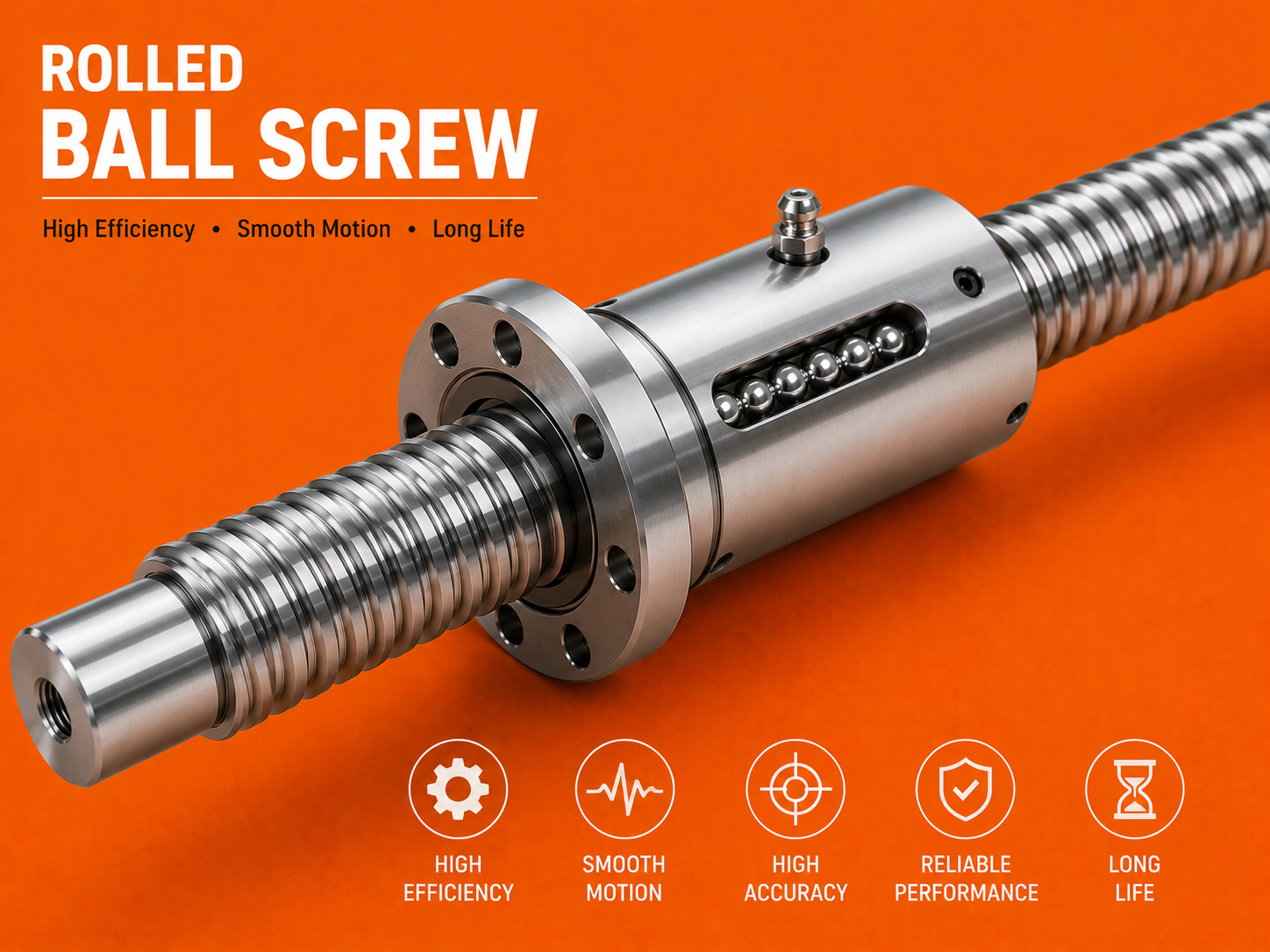 | Precision Ballscrews Balaji Engineering Works offers high-quality Rolled Ball Screws in Pune, designed for efficient linear motion with excellent performance and... View product → |
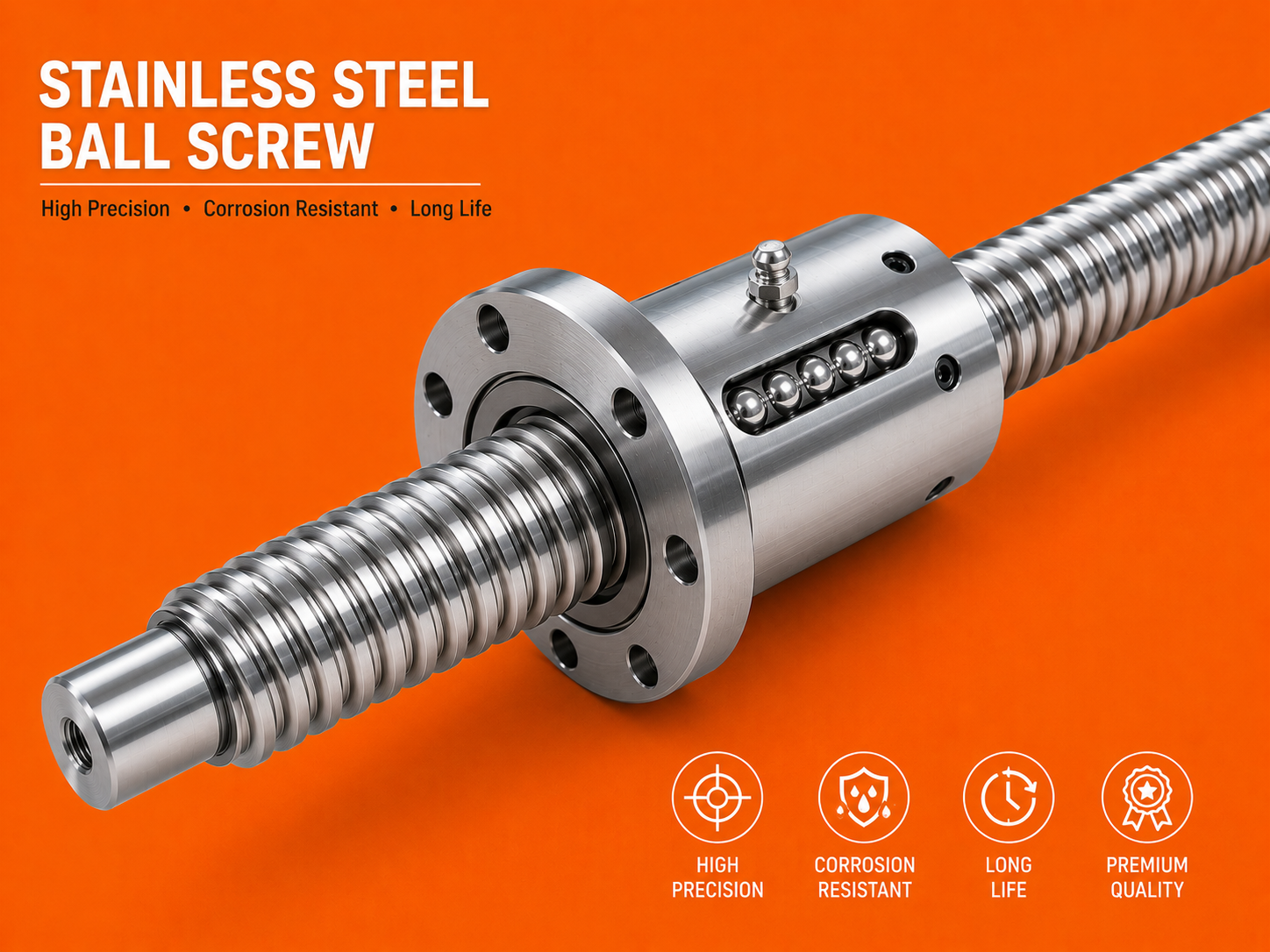 | Precision Ballscrews Balaji Engineering Works offers high-quality Stainless Steel Ball Screws in Pune, designed for precision linear motion with excellent corrosion... View product → |
Frequently asked questions
How do industrial ball screws work?
A motor rotates the threaded screw shaft while recirculating steel balls roll between the shaft and nut, converting rotation into precise linear travel with low friction.
When is a ball screw the right drive?
Choose a ball screw when your machine needs accurate positioning, repeatable motion, high efficiency, or substantial axial force. Use another drive when contamination, shock loads, low cost, or maintenance limits make rolling-contact components unsuitable.
How do you size an industrial ball screw?
Check the required axial load, screw lead, maximum speed, critical speed, positioning accuracy, stiffness, mounting arrangement, duty cycle, lubrication, and calculated service life.
What is the difference between rolled and ground ball screws?
Rolled ball screws are formed by pressing the thread profile into the material and suit many standard machine applications. Ground ball screws are finished by grinding for tighter accuracy and smoother precision motion.
What is the difference between single-nut and double-nut ball screws?
A single nut is compact and economical. A double nut uses preload between two nuts to reduce backlash and increase stiffness, making it suitable for demanding CNC positioning.
Related products
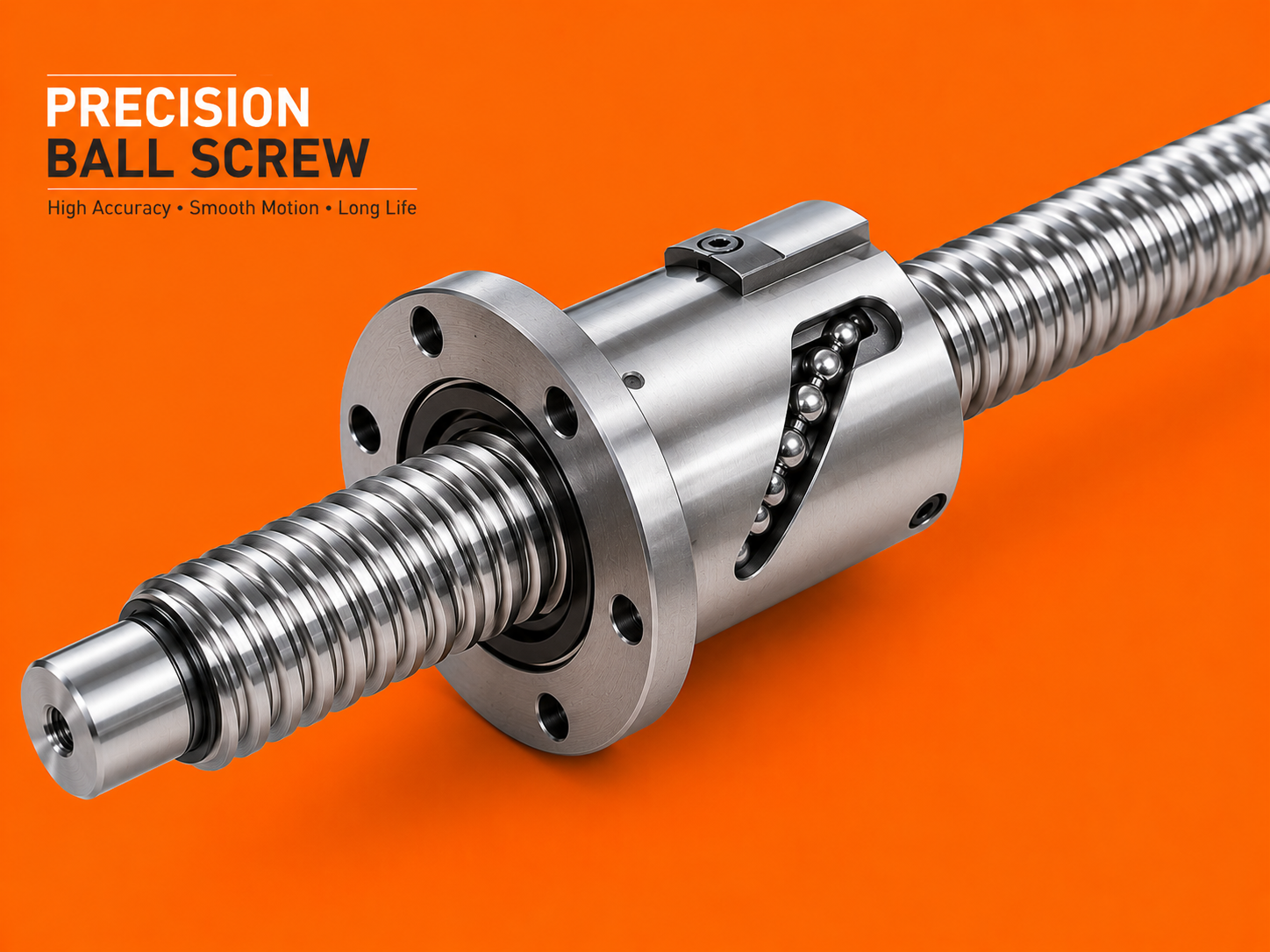 | Precision Ballscrews Balaji Engineering Works is a trusted manufacturer and supplier of Precision Ball Screws in Pune, designed for high-accuracy linear motion and... View product → |
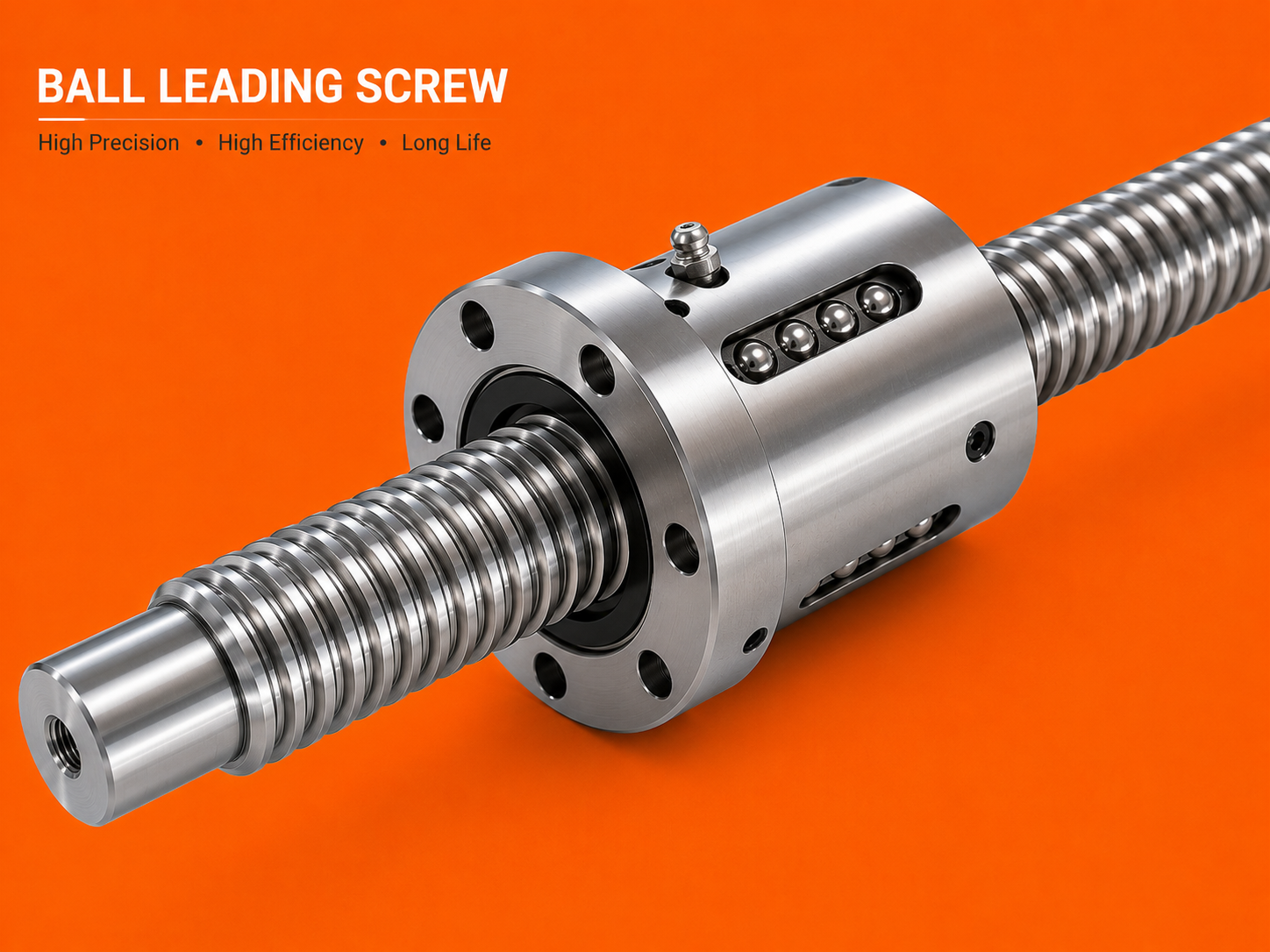 | Precision Ballscrews Balaji Engineering Works offers high-quality Ball Lead Screws in Pune, designed for precise and efficient conversion of rotary motion into linear... View product → |
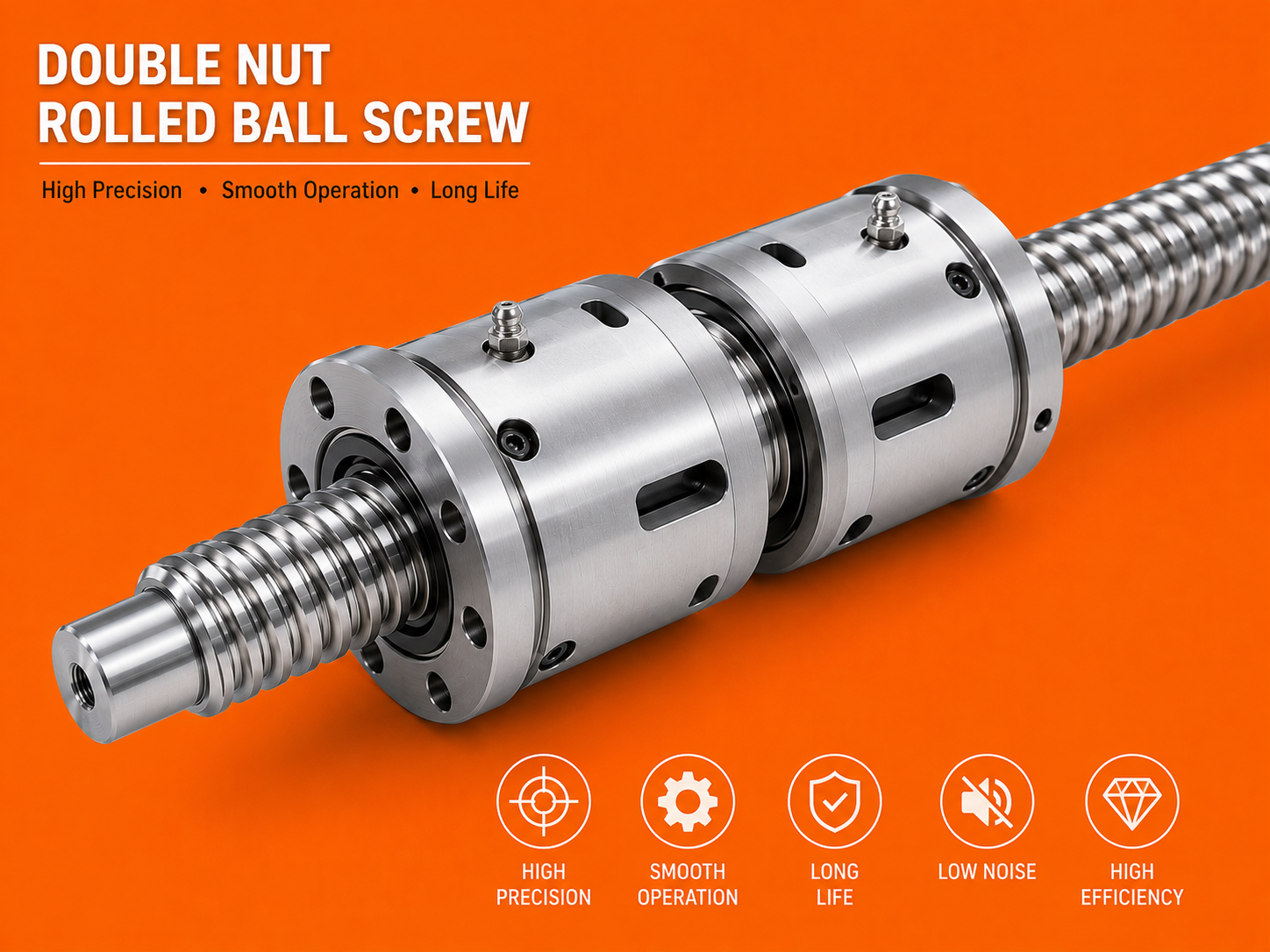 | Precision Ballscrews Balaji Engineering Works offers high-performance Double Nut Rolled Ball Screws in Pune, designed for applications requiring reduced backlash,... View product → |
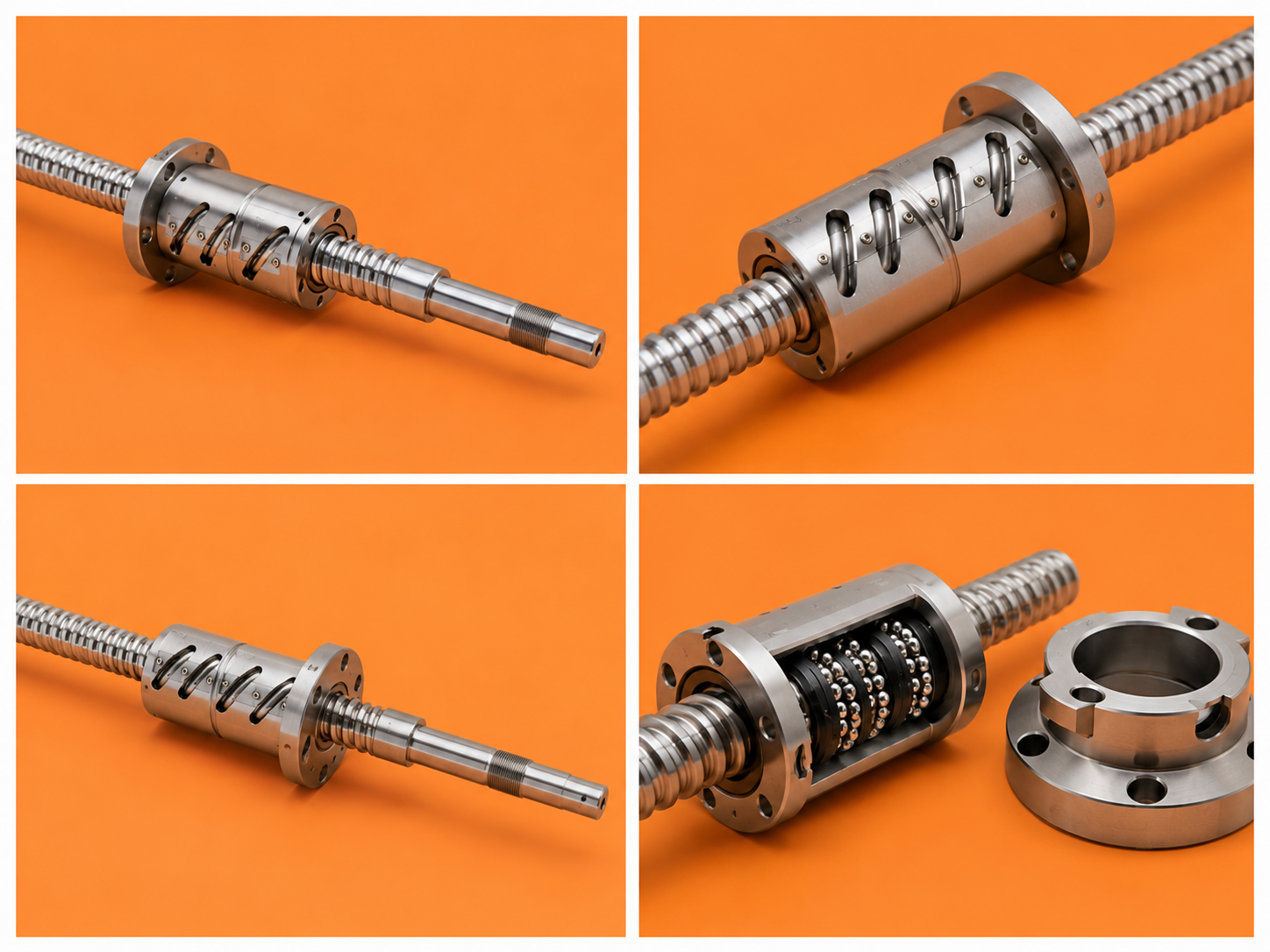 | PRECISION GROUND BALL SCREW We are Manufacturing of precision Ground ball screw with nut As per Customer View product → |