
A double nut is justified when reversal accuracy and axial stiffness matter enough to offset extra length, preload friction, heat, and cost. By comparing the error source, axis duty, accuracy target, and supplier data, you can decide whether a double nut rolled screw fits your machine or whether a single nut, ground screw, or different linear-motion system is the better choice.
Key takeaways
- Choose two nuts when measured backlash or stiffness requirements justify preload.
- Prove backlash with reversal tests before specifying a double nut assembly.
- Match preload, lead, accuracy class, load, speed, and support conditions.
- Choose rolled screws for practical CNC performance, cost, and delivery advantages.
Which buyers have a real reason to choose two nuts?
Choose two nuts when reversing load exposes measurable backlash or when the axis has a defensible stiffness target. The buyers with the clearest case are:
| Buyer | Machine condition | Why two nuts apply |
|---|---|---|
| Machine-tool builder | CNC axis reverses under cutting load | Higher axial stiffness and controlled reversal play |
| CNC retrofitter | Measured lost motion remains after checking the screw | Preload can remove screw-level axial clearance |
| Automation integrator | Bidirectional positioning must repeat | Less reversal error matters more than minimum size and friction |
| General machine builder | Modest, mainly one-way load | A single nut usually costs less and starts with lower torque |
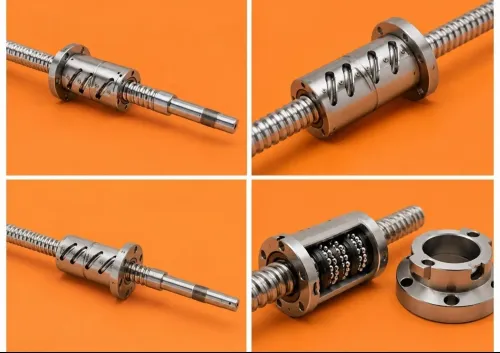
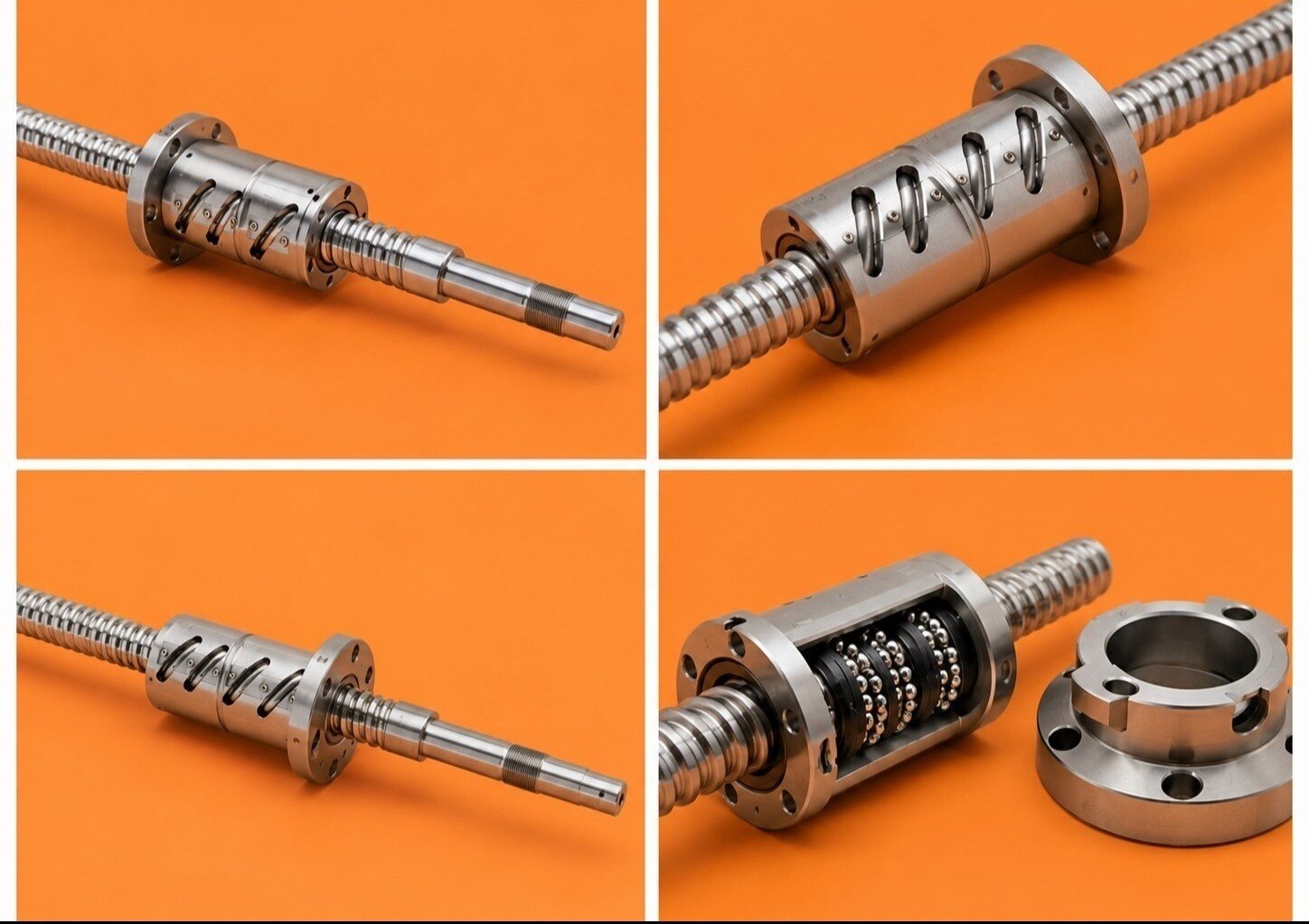
A double nut ball screw for machine tools uses two nut bodies separated by a spacer, or two nuts set with a controlled lead offset. That arrangement imposes preload between the balls, raceways, and nut assembly, removing axial clearance and improving stiffness as the load changes direction. It is not twice the nominal load rating.
Preload does not remove lead error, thermal growth, guideway deflection, coupling looseness, or structural compliance. Confirm that the screw causes the measured reversal error before specifying a double nut.
Choose a single nut when the axis has no measured reversal error, low duty, modest positioning forces, predominantly one-directional loading, short assembly length, limited packaging space, or no quantified stiffness requirement. It is also the better choice when added friction, starting torque, heat, adjustment, and cost have no clear performance benefit.
A double nut rolled ball screw is the wrong upgrade when the machine has not identified which error needs correcting.
How do you prove that backlash is the problem?
Measure reversal error before ordering a double nut: command equal positive and negative moves at the working load, then compare actual position.
1. Mount a dial indicator at the axis, or use a laser interferometer or ballbar for a fuller error map. Record the position during approach from both directions, not just the controller’s commanded value.
2. Repeat the reversal test at several travel positions and under cutting force. A result that changes with direction, travel position, warm-up time, temperature, or servo gain is not automatically screw backlash.
3. Isolate mechanical causes. Check coupling looseness, loose bearing locknuts, angular-contact bearing play, guideway wear, loose mounting bolts, structural deflection, and servo following error. A coupling that twists during acceleration needs correction at the coupling or motor interface.
4. Check alignment before blaming the nut. Poor parallelism or a guideway that binds can create cyclic torque, uneven ball loading, heat, and false backlash readings. Do not use the screw to absorb alignment errors.
5. Separate reversal play from lead accuracy. A preloaded double nut can remove axial clearance at the screw while leaving systematic lead error across the travel. Pitch-error mapping can compensate repeatable lead variation, but not reliably correct elastic deflection, random local error, poor parallelism, or thermal growth.
6. Record reversal error, load, temperature, required repeatability, and the error remaining after alignment. Give these figures to a ball screw manufacturer for CNC applications; otherwise, added preload can become an expensive substitute for machine repair.
Which specifications determine whether the double nut will run well?
A double-nut ball screw for machine tools must be sized from the complete axis duty, not nominal diameter alone. Record nominal diameter, lead, travel length, axial load in both directions, maximum rpm, acceleration, duty cycle, mounting orientation, ambient temperature, lubrication, allowable noise, positioning accuracy, and repeatability.
Check these limits before approving the screw:
- Verify dynamic and static load ratings against the equivalent axial load.
- Calculate buckling for the actual vertically or horizontally mounted screw, bearing span, support arrangement, and compression load.
- Check critical speed, DN limit, nut design, permitted rpm, and heat at the actual duty cycle.
- Ask for the permitted speed or critical-speed calculation for the fixed-support arrangement. A larger diameter can carry more load yet fail the rpm requirement.
- Reserve space for both nuts, the spacer or adjustment hardware, seals, retention, lubrication access, and bearing span.
| Input | What to request | Why it matters |
|---|---|---|
| Axial duty | Load in both directions, acceleration, cycle time | Reversal load drives stiffness and motor torque |
| Speed | Maximum rpm, DN limit, critical-speed result | Excess speed causes vibration, heat, or failure |
| Accuracy | Positioning accuracy and repeatability | Diameter alone does not establish motion accuracy |
| Preload | Percentage or measured starting torque, measurement speed, lubricant | Higher preload reduces clearance but raises friction, power, heat, stress, and life risk |
Use the rating-life comparison proportional to (C/P)³, not as a guarantee. Contamination, misalignment, shock, poor lubrication, and preload reduce practical life. Align the screw to the guideways; never use the nut to absorb parallelism errors.
When is a rolled screw better than a ground screw or another drive?
Choose a rolled screw when its measured lead accuracy and stiffness satisfy the axis error budget at a lower cost and shorter delivery time than a ground screw.
Rolling forms the thread by plastic deformation. It supports practical standard production and readily available long lengths. Grinding after hardening gives tighter lead accuracy and finer geometric control for demanding contouring, thermal-error, and geometric-control budgets.
Do not infer accuracy from “double nut,” “precision,” or “for CNC.” Compare total lead error over the travel, local lead variation, axial runout, inspection length, accuracy class, delivery time, and price.
| Option | Strength | Limitation | Best fit |
|---|---|---|---|
| Double-nut rolled ball screw | Controlled reversal play and useful stiffness at lower cost | Added preload, friction, length, and adjustment | Cost-sensitive CNC positioning within the measured error budget |
| Double-nut ground screw | Tighter lead and geometric control | Higher price and longer delivery | Tight contouring and demanding thermal-error budgets |
| Rack-and-pinion | Long travel without screw critical-speed limits | Gear mesh and reversal errors | Long axes |
| Linear motor | No screw inertia or mechanical contact | Expensive feedback, thermal management, and rigid structure | High-performance axes with strict control |
| Trapezoidal lead screw | Simple and potentially self-locking | Low efficiency and unsuitable high-cycle CNC performance | Low-speed, low-duty mechanisms |
A single-nut rolled screw wins when loads are simple, packaging is tight, friction must stay low, and cost dominates. A double nut is not twice the accuracy or load rating.
Ask a double nut rolled ball screw manufacturer to document the actual lead class, stiffness, runout, inspection length, and delivery date before comparing quotations.
What should you demand from a rolled ball screw supplier?
Put acceptance conditions on the quotation, not in a conversation. A rolled ball screw supplier must identify the actual screw and nut, because “preloaded,” “precision,” and “for CNC” do not establish performance.
Ask for:
- Accuracy class or applicable standard, total lead error, local lead variation, axial runout, inspection length, and inspection record
- Nominal diameter, lead, travel, dynamic and static load ratings, allowable speed, and the critical-speed calculation for the support arrangement
- Preload value or measured starting torque, measurement speed, lubricant used during measurement, recommended lubrication, seal arrangement, and mounting guidance
- Screw-and-nut serial traceability, packaging length, spacer or adjustment details, lubrication access, replacement availability, and alignment tolerances
- Written confirmation that the assembly handles axial load in both directions, acceleration, duty cycle, orientation, temperature, and motor torque
| Claim | Evidence to require | Why it matters |
|---|---|---|
| Preloaded | Preload percentage or starting torque and test method | Higher preload raises stiffness but also friction, heat, and motor demand |
| Precision | Accuracy class, total lead error, local variation, and runout over a stated length | A double nut does not remove lead error |
| For CNC | Speed limit, load ratings, lubrication, and inspection data for the actual assembly | A ball screw manufacturer for CNC must size the complete duty, not just diameter |
Balaji Engineering Works can be considered for a standard or non-standard configuration, but compare its documented data for the actual assembly. Choose the double nut only when that evidence justifies its added envelope, adjustment, friction, and cost.
Related products
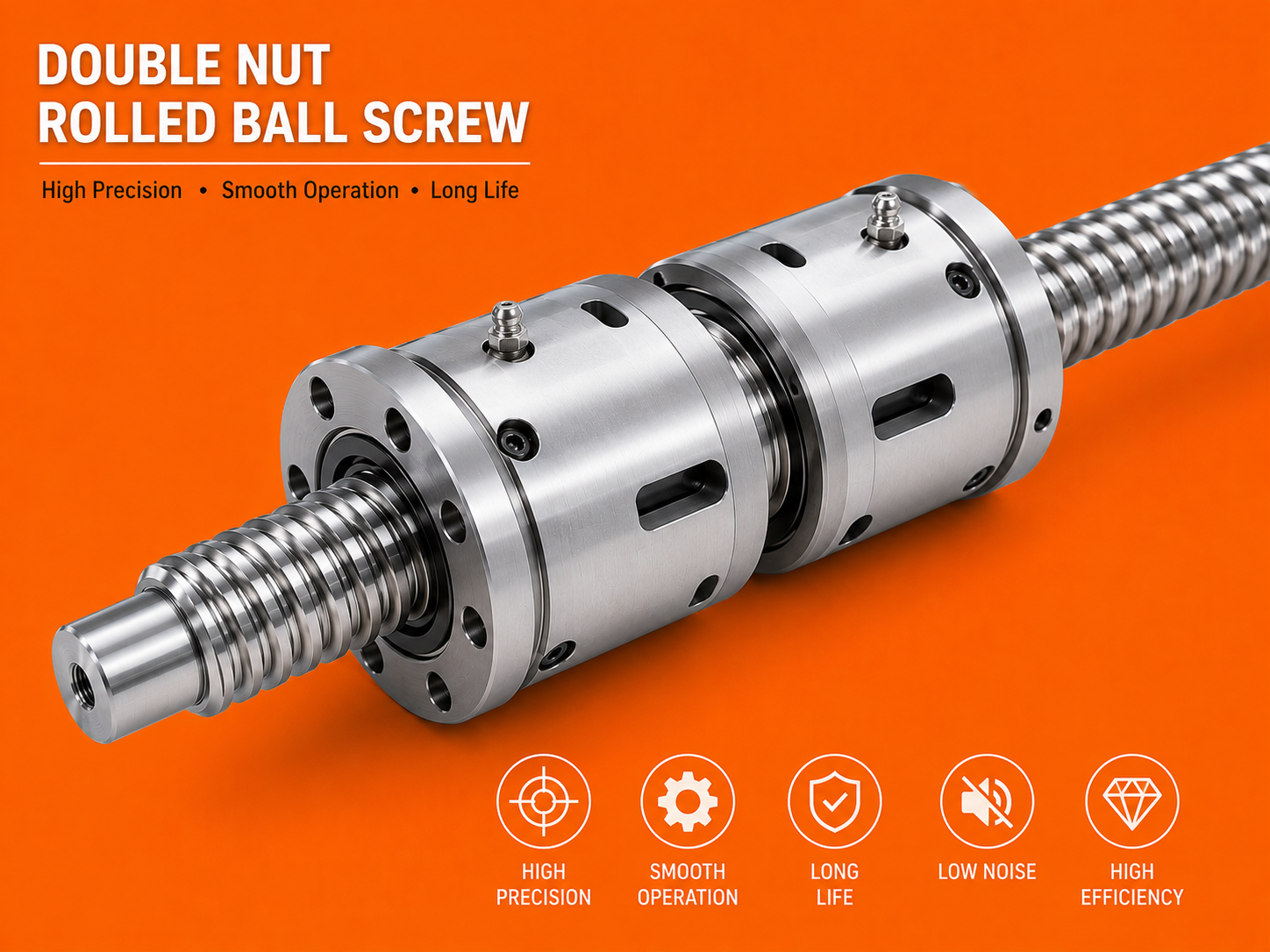 | Precision Ballscrews Balaji Engineering Works offers high-performance Double Nut Rolled Ball Screws in Pune, designed for applications requiring reduced backlash,... View product → |
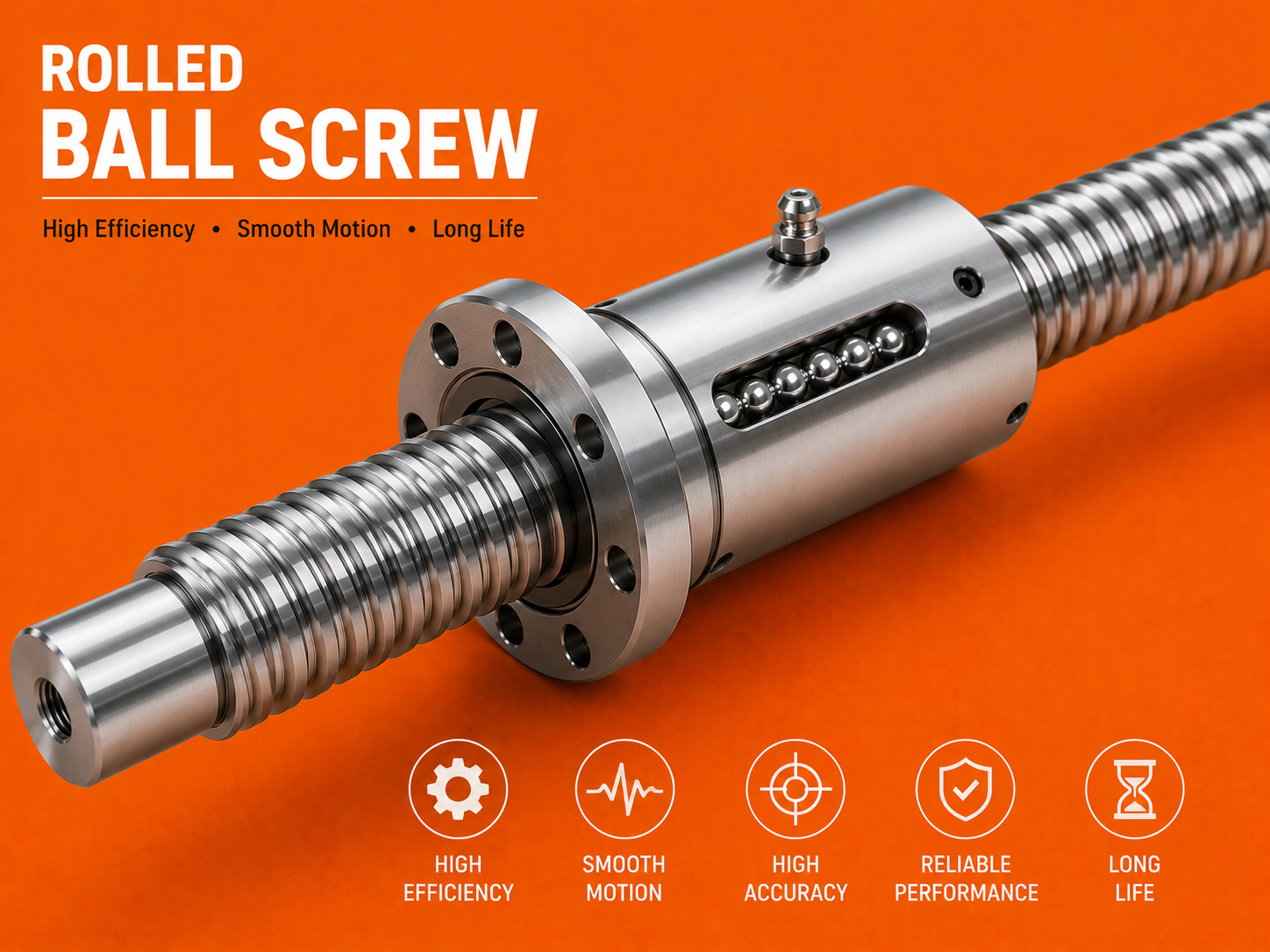 | Precision Ballscrews Balaji Engineering Works offers high-quality Rolled Ball Screws in Pune, designed for efficient linear motion with excellent performance and... View product → |
Frequently asked questions
Which buyers have a real reason to choose two nuts?
Choose a double nut ball screw when reversal exposes measurable backlash or the axis requires a documented stiffness target. Machine-tool builders, CNC retrofitters, and automation designers with changing or reversing loads have the clearest case.
How do you prove that backlash is the problem?
Measure bidirectional positioning at the same location with a dial indicator, laser interferometer, or calibrated linear scale. Reverse direction under the machine’s operating load and separate lost motion from servo tuning, coupling compliance, bearing clearance, and structural flex.
Which specifications determine whether the double nut will run well?
Specify nominal diameter, lead, usable length, accuracy class, preload, axial load, critical speed, mounting arrangement, lubrication, and operating temperature. Check the nut’s static and dynamic load ratings against the duty cycle rather than selecting by diameter alone.
When is a rolled screw better than a ground screw or another drive?
A rolled screw suits applications that need repeatable CNC motion, practical accuracy, lower cost, and faster availability without ground-screw accuracy. Choose a ground screw for tighter geometric accuracy, and compare rack-and-pinion or belt drives when travel length or speed dominates.
What should you demand from a rolled ball screw supplier?
Request a drawing, accuracy and preload data, load ratings, pitch or lead information, runout limits, inspection results, lubrication guidance, and traceability for the supplied assembly. Confirm that the supplier can match the screw, double nut, supports, and application duty rather than quoting a nut alone.