

Clicking, grinding, rumbling, squealing, or rhythmic knocking from a ball-screw assembly can indicate anything from normal recirculating-ball contact to a damaged raceway, incorrect preload, or a floating-end support installed under stress. You will be able to classify the sound, isolate its source, check the BF support and installation, and define the evidence needed before repair or replacement.
Key takeaways
- Stop the machine for grinding, sharp clicks, rumbling, or rapidly worsening vibration.
- Compare unloaded forward and reverse travel at a defined speed.
- Check BF floating-end alignment, mounting, preload, lubrication, and contamination before replacement.
- Accept a replacement only after defined noise, runout, preload, and travel tests.
What the Noise Pattern Tells You—and When to Stop the Machine
A light, consistent rolling sound from ball recirculation can be normal. Grinding, sharp clicking, rumbling, squealing, rhythmic knocking, or noise that rises with acceleration requires investigation. Test unloaded motion at a defined speed, then compare forward and reverse travel. Note whether the sound repeats at the same screw position and whether vibration increases during acceleration.
| Pattern | Likely direction | What to check |
|---|---|---|
| Consistent rolling sound | Normal recirculation | Confirm stable temperature, current, and positioning |
| Same screw position each pass | Raceway damage, brinelling, contamination, or damaged return tube | Inspect the nut, seals, raceway, and return path |
| Mainly during reversal | Backlash, preload transition, loose mounting, control-loop excitation, or return-system damage | Compare forward/reverse motor-current traces |
| Rises with acceleration | Resonance, mounting fault, lubrication problem, or developing damage | Measure vibration at the bearing housing and nut mount |
Stop the machine after a sudden noise change, rising temperature, binding, visible scoring, increasing motor current, or vibration that threatens positioning accuracy. Do not judge industrial ball screw noise from a microphone reading alone.
Treat BF type ball screw vibration in Pune as an installed-machine problem: record travel, speed, load, temperature, warm-up time, coolant exposure, chip contamination, anchoring, and foundation or frame changes. These conditions alter alignment and resonance, so a repeatable position-based sound needs diagnosis before continued production.
How to Prove Whether the Ball Screw Is Actually the Source
To isolate industrial ball screw noise, remove competing sources in a controlled sequence rather than trusting your ears or one dB reading.
- Run the axis at a defined speed, then disconnect the servo motor where safe. Rotate the screw by hand through full travel and note tight spots, position-specific sounds, and roughness.
- Inspect the coupling spider, hubs, clamps, and gearbox interface. Check guide-block motion for drag, chipped rollers, or uneven resistance, then repeat the test with the nut unloaded and loaded.
- Mount accelerometers on the bearing housing and nut mount. Compare the time waveform, rotational-order plot, and FFT or frequency spectrum while recording direction, acceleration, and warm-up condition.
- Record motor current, axial positioning error, temperature, and the machine’s ambient, coolant, chip, anchoring, and frame conditions.
A microphone or overall dB value cannot identify the fault because motor, coupling, bearing, guide, gearbox, chips, and frame resonance can overlap.
| Observation | Stronger indication | Confirmation |
|---|---|---|
| Tone synchronized with screw rotation | Screw geometry, bearings, coupling, or contamination | Compare rotational orders and hand-rotation positions |
| Peak at one speed | Shaft critical speed or machine natural frequency | Change speed slightly and repeat |
| Noise only under load | Nut, preload, guide, or mounting load path | Compare unloaded and loaded spectra |
A speed change confirms resonance; it does not repair it. A repeatable test record prevents a warm-up or load difference from being mistaken for a ball-screw defect.
How the BF Floating End Creates or Reveals Vibration
The BF end is the floating support, not a second axial locator. The fixed end locates the screw axially; the BF end allows thermal expansion. Locking both ends axially creates thermal stress, higher drive torque, heat, and vibration.
Check the BF support in this order:
- Inspect raceways for scoring or brinelling, and remove contamination from balls, return paths, and seals. Worn balls or a damaged return tube produce rough rolling, clicking, or rhythmic vibration.
- Verify preload. Excessive or incorrect ball-screw preload raises friction, torque, and temperature; incorrect bearing preload does the same at the support.
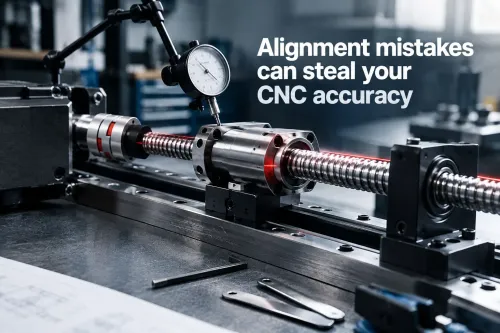
- Check mounting faces, datum shoulders, bearing seats, and fasteners. A bearing pressed out of square, loose support bolts, or a misaligned bearing seat forces the screw to orbit instead of rotate smoothly.
- Confirm that the housing bore is coaxial with the screw and that no shoulder axially traps the BF bearing. Either fault defeats floating movement.
- Measure shaft runout with the screw installed in both supports, not only with the screw removed. A straight loose screw can bend after end journals, seats, or mounting references constrain it.
- Move the nut through full travel and record torque and noise. A position-dependent change points to alignment, raceway, or return-system damage.
For BF type ball screw vibration in Pune, record temperature and travel conditions before replacing parts. A replacement nut with matching diameter and lead is not interchangeable when its preload class differs.
Installation and Lubrication Checks Before Replacing the Screw
Do not condemn the ball screw until installation has been checked in this order:
- Clean the mounting faces and remove chips, burrs, coolant residue, and dried grease.
- Inspect datum shoulders and bearing seats for damage, dirt, or raised metal.
- Confirm shaft and housing coaxiality; check runout with the screw installed in its supports.
- Seat the fixed and BF support units without forcing the bearings or pulling them into alignment with bolts.
- Tighten support-unit bolts in a crosswise sequence to the specified torque.
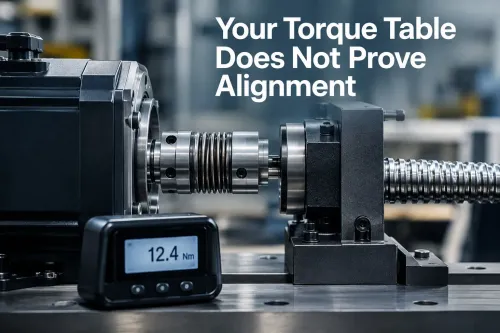
- Align the coupling and inspect its spider, clamps, and keyway for distortion.
- Verify bearing orientation, including the floating function at the BF end.
- Rotate the screw through its full travel before connecting the motor. Any tight spot or position-dependent noise needs investigation.
Check the end-machining drawing, not just the screw diameter and lead. Confirm journal diameter, shoulder location, thread length, datum relationships, and bearing-seat fit; an incorrect detail can bend the installed screw or transfer assembly stress into it.
Use only grease or oil approved for that screw. Keep chips and coolant away from seals and ball-return paths.
| Condition | Likely effect |
|---|---|
| Excess grease | Churning, heat, and running resistance |
| Dried or insufficient lubricant | Rough rolling and rising temperature |
Obtain the exact lubricant type, quantity, application procedure, relubrication interval, speed range, load, temperature limit, and seal compatibility from the screw maker or maintenance manual. Do not invent an interval from a general bearing chart.
How to Specify and Accept a Low-Noise Replacement
Accept a replacement only when its specification and test record match the installed job, not when a supplier labels it “low noise.”
1. Request the screw and nut series, nominal diameter, lead, ISO 3408 accuracy grade, effective travel, preload method and class, measured runout, rated load, operating speed, and lubrication state.
2. Obtain the end-machining drawing showing journal diameters, shoulder locations, thread lengths, bearing-seat fits, and datum relationships. Confirm the support arrangement, including fixed-end and floating-end units such as BK/BF.
3. Require inspection results for accuracy, runout, preload, and dimensional conformity, plus a written replacement policy covering mismatch, installation damage, and noise found during acceptance.
4. Test the original and replacement under identical speed, acceleration, load, travel, warm-up duration, lubrication condition, and measurement location. Retain the time waveform, frequency or order spectrum, temperature, motor current, and positioning error; an overall dB value alone can hide a narrow-band defect.
5. Record ambient temperature, coolant exposure, chip contamination, anchoring, and frame changes. A supplier bench test cannot reproduce an installed resonance if the machine structure or environment differs.
6. Treat quotations as comparable only when these fields match. That applies to a ball screw manufacturer in Pune and a precision ballscrew manufacturer in Pune. Balaji Engineering Works belongs in the comparison when its quotation and inspection records identify these details rather than relying on “precision” or “low noise.”
Related products
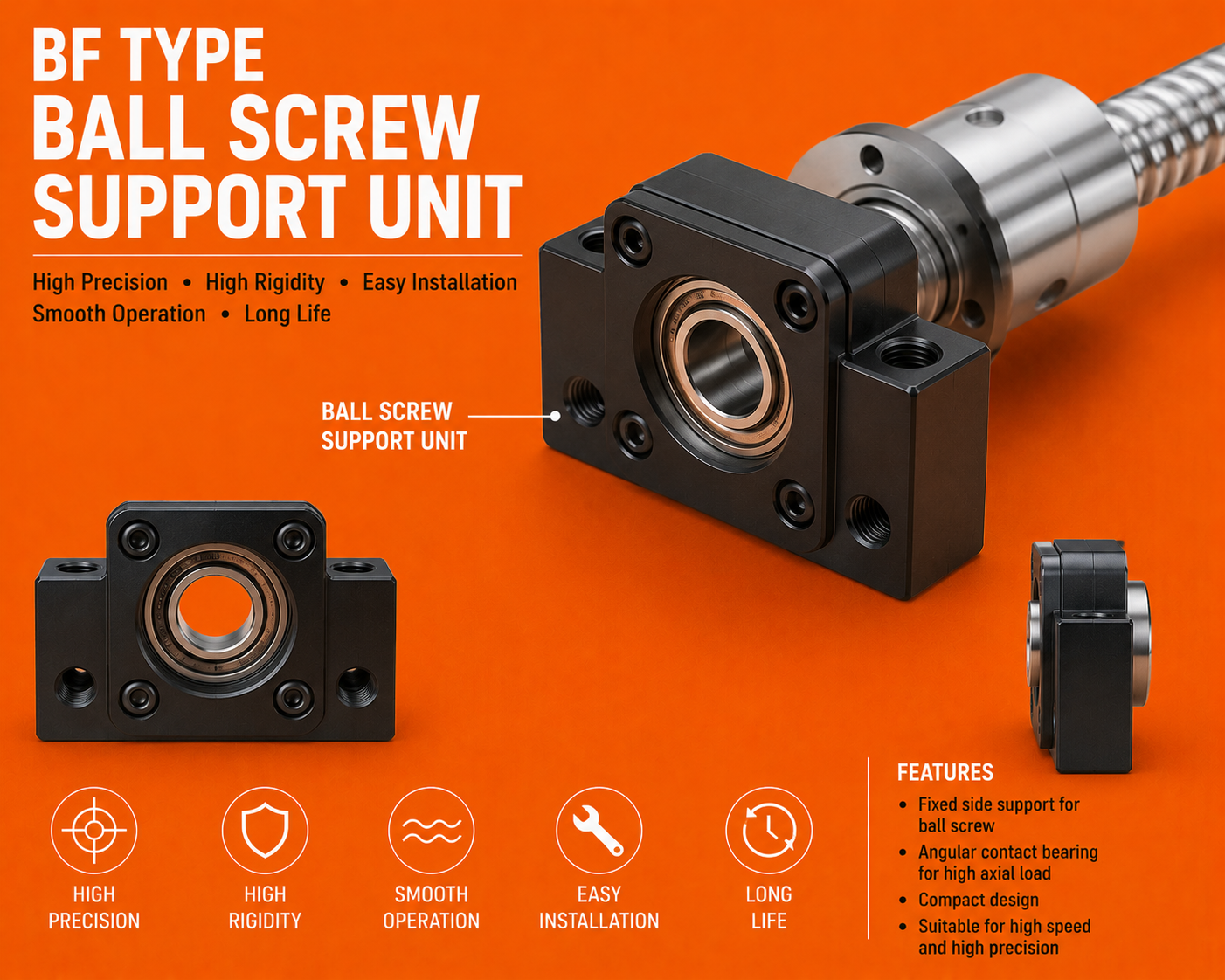 | Bf Type Ball Screw Support Unit Bf Type Ball Screw Support Unit Balaji Engineering Works offers high-quality BF Type Ball Screw Support Units, designed to provide reliable support for the floating end of ball... View product → |
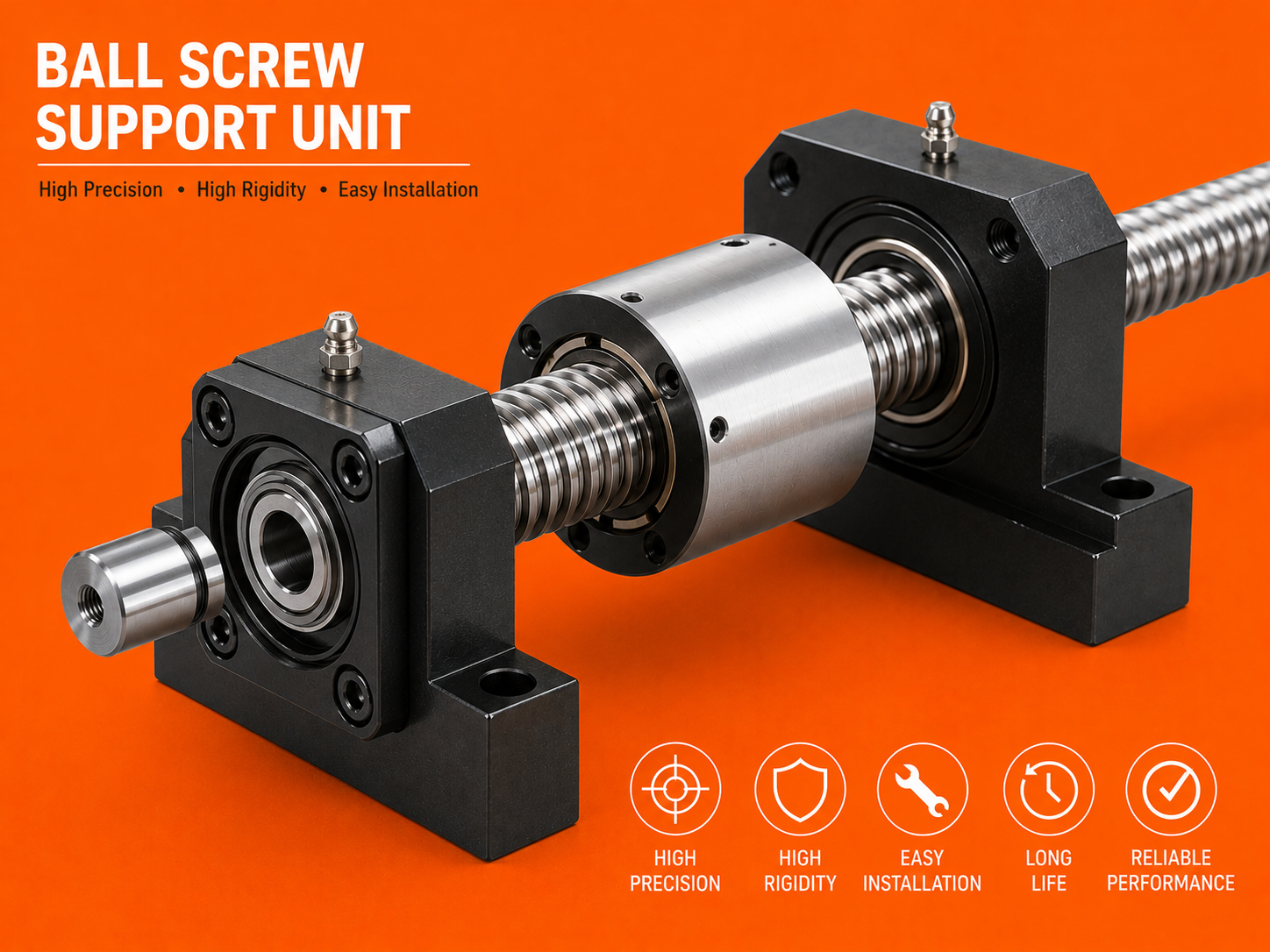 | Precision Ballscrews Balaji Engineering Works offers high-quality Ball Screw Support Units in Pune, designed to provide stable and precise support for ball screw... View product → |
Frequently asked questions
Which ball screw noise patterns require stopping the machine?
Stop for grinding, sharp clicking, rumbling, squealing, rhythmic knocking, or vibration that worsens rapidly with acceleration.
How can you prove the ball screw is the noise source?
Run the axis unloaded at a defined speed, compare forward and reverse travel, and check whether the sound repeats at the same screw position.
How can the BF floating end cause ball screw vibration?
Incorrect alignment, excessive restraint, bearing damage, or incorrect mounting at the BF floating end can create or expose vibration during travel.
What should you check before replacing a noisy ball screw?
Inspect mounting alignment, bearing condition, lubrication quantity and type, contamination, preload, coupling alignment, and screw runout.
How do you specify and accept a low-noise replacement?
Define size, lead, accuracy grade, preload, runout, lubrication, inspection records, and acceptance tests for noise, vibration, and full travel.