
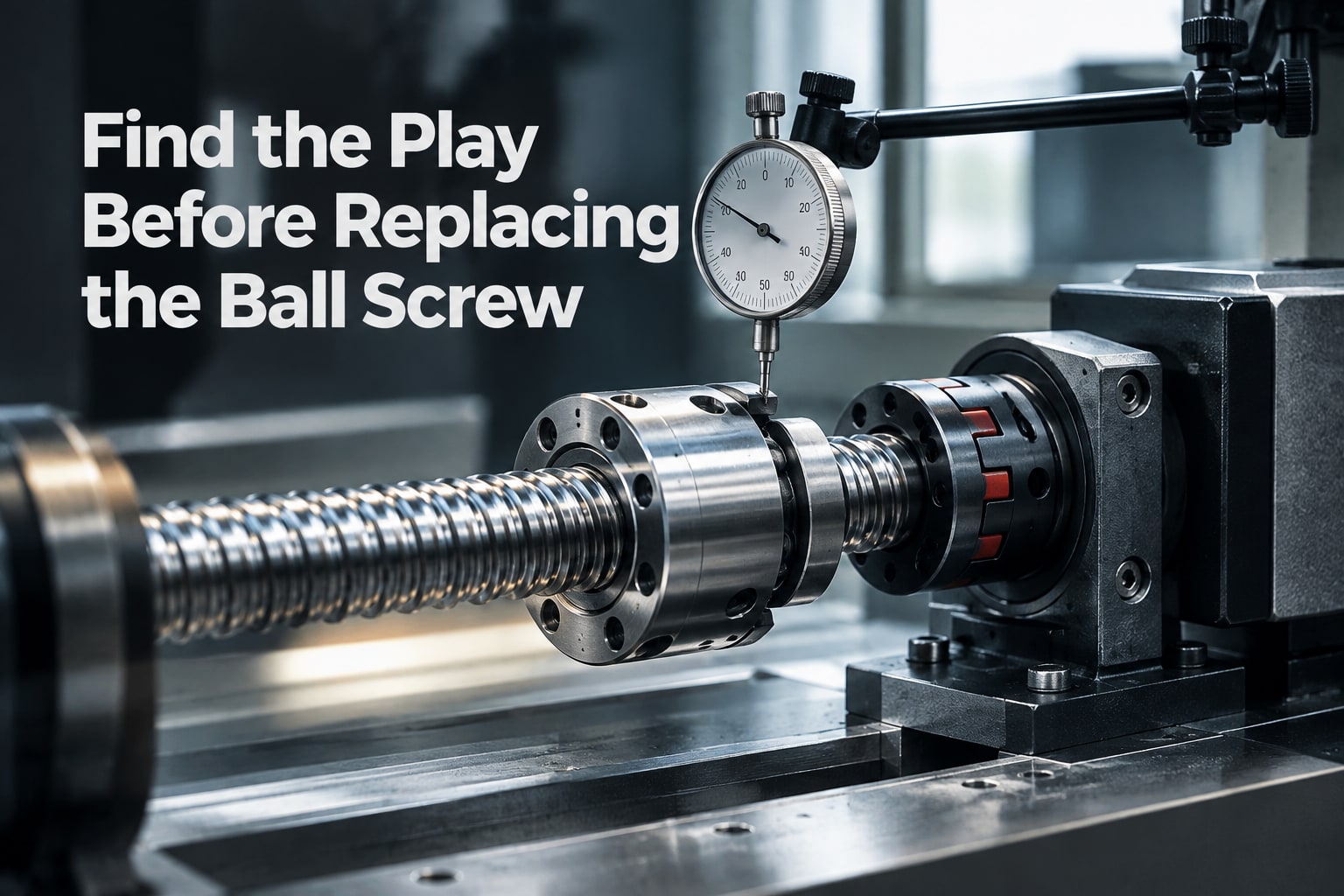
Backlash is the axial movement you record after reversing force but before the ball screw nut begins moving in the opposite direction. A controlled reversal test, repeated at several points and loads, lets you separate internal nut play from coupling movement, bearing looseness, thermal growth, servo error, and guideway clearance.
Key takeaways
- Measure reversal play with an external dial indicator, not the CNC position display.
- Repeat the test from both travel directions to confirm a backlash signature.
- Check couplings, bearings, guides, and mounting before blaming the ball screw nut.
- Inspect BF support preload, looseness, contamination, and retaining hardware before replacement.
What backlash looks like in a ball screw axis
A backlash signature is a repeatable dead zone at direction reversal: the screw or motor changes direction, but the nut and machine slide do not move immediately. Measure that delay with an external dial indicator or laser, because the CNC position display can report movement even while mechanical motion is absent.
Signs pointing to mechanical backlash include:
- The indicator shows a consistent jump or pause whenever the axis reverses, regardless of whether the reversal occurs at slow feed or during a controlled test.
- The lost motion changes with the direction of the applied axial load, then disappears once the nut contacts the opposite ball track.
- Circular interpolation produces a repeatable mismatch between the two sides of a circle, while straight travel in one direction remains comparatively accurate.
- The error remains tied to reversal rather than to one coordinate on the screw.
Servo following error usually appears during acceleration and shrinks when speed or load is reduced. Encoder resolution and position-loop deadband create small command-related steps, not a sustained mechanical gap. Slide friction or coupling torsion can delay movement under force, but the delay changes with acceleration, lubrication, or load.
Thermal growth shifts position as the screw heats; it does not create a reversal-only dead zone. Lead error repeats with screw travel, while industrial ball screw backlash appears mainly when direction changes.
If reversal play varies sharply along the stroke and is accompanied by noise, heat, or changing torque, inspect alignment and supports before blaming the nut.
How to measure reversal play with an indicator
Let the screw, nut, bearings, and housing reach a repeatable thermal condition before testing. Record screw temperature, axis position, indicator resolution, axial test load, and approach direction; thermal growth can create a large position error without mechanical backlash.
- Mount a dial indicator or test indicator rigidly to the machine frame, with its tip contacting the nut housing or moving carriage along the screw axis. Remove loose tooling and keep the indicator near the line of force.
- Select three or more positions—near the fixed end, mid-stroke, and near the BF floating end. Mark them so you can repeat the test later.
- Approach each position from the same direction at low speed. Stop, allow motion to settle, and zero the indicator. Use the servo brake or motor holding torque while setting the reference; release it only for the controlled reversal.
- Command a small, fixed reverse move, such as 0.1 mm, at the same feed rate and axial load each time. The indicator movement before the carriage follows is reversal play.
- Record the peak indicator change during the dead zone, then continue the move and record the final position. Repeat the reversal at least three times at each position.
- Compare readings by position. A consistent reversal-related gap supports industrial ball screw backlash; a smooth error that changes with travel points toward lead error or thermal drift.
Do not compare a backlash number without its test load, measurement location, preload, lead and accuracy class, and temperature. Those conditions determine whether supplier results are comparable.
How to separate nut backlash from other axis errors
True nut backlash produces repeatable lost travel at every reversal, while most other errors change with speed, load, position, or temperature. Use an external indicator or laser measurement at the machine output; the motor encoder alone cannot prove that the nut moved.
- Warm the screw, nut, bearings, and housing to a repeatable condition. Record screw temperature and test position, then repeat the reversal at several stroke locations.
- Run the same low-speed reversal with the servo enabled and disabled where the machine permits. Compare commanded position, encoder position, and external movement; following error that changes with gain, speed, or servo state is not nut backlash.
- Repeat the test at low and higher axial loads. A large change points to elastic deflection, coupling torsion, bearing movement, slide clearance, or structure compliance rather than internal nut clearance.
- Check the BF end separately. Measure axial movement at the screw end and inspect bearing seating, retaining-nut torque, shoulder contact, housing fit, and axial clearance before condemning the nut.
| Error | Diagnostic signature | Confirmation |
|---|---|---|
| Servo following error | Changes with speed, gain, or acceleration | Compare encoder and external readings |
| Pitch error | Position error follows screw location, not reversal direction | Map both travel directions |
| Thermal growth | Drifts with temperature and time | Repeat after thermal stabilisation |
| Coupling torsion | Changes with torque and springs back | Test different loads and inspect coupling |
| Bearing movement | Error is greatest near a support or with axial load | Measure screw-end movement |
| Slide clearance | Depends on guideway load or approach direction | Indicator-test the slide independently |
What to inspect in the BF floating-end support
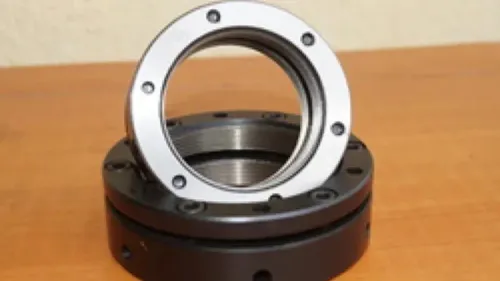
An axial shift at the BF floating-end support can look exactly like ball-screw nut backlash because the screw moves before the indicator sees table movement. BF denotes the free-support end, not a backlash rating; its bearing supports the screw while allowing designed thermal growth, but it must not have uncontrolled axial play.
1. Lock the motor and measure axial movement at the screw while applying equal push-pull force. Movement at the BF shaft, bearing inner ring, or housing indicates support movement rather than clearance inside the nut.
2. Check the bearing’s axial clearance, retaining-nut torque, shoulder contact, and housing fit. A loose retaining nut, an unseated bearing, a damaged race, or a loose housing bore can create reversal play.
3. Inspect mounting bolts, spacers, circlips, and the BF-to-screw seating surfaces. An incorrectly installed bearing, missing spacer, or contact against the wrong shoulder can preload the bearing incorrectly or leave end float.
4. Rotate and traverse the screw slowly. Roughness, clicking, heat, changing torque, visible runout, or uneven raceway marks point toward bearing damage or misalignment. Confirm screw, BF, fixed-end support, nut housing, and guideways share the intended axis.
5. Repeat the reversal test at several stroke positions and load levels, both cold and at operating temperature. If the reading changes sharply with load or position, include elastic deflection and alignment in the diagnosis before replacing the nut.
A search for “bf type ball screw backlash in pune” describes a location and product, not a technical specification. State the screw diameter, lead, preload, support arrangement, load, temperature, and measured play when requesting advice.
What evidence to request before approving a replacement
Do not approve a replacement from a quoted backlash value alone. Ask the supplier to identify the exact screw and nut assembly, then provide results taken under stated test conditions. A local source does not prove that its BF assembly matches the original preload, accuracy class, or support arrangement.
Request these records:
- Screw diameter, lead, length, stroke, nut type, preload, accuracy or lead class, and fixed-end/free-end bearing arrangement.
- Axial-play or preload specification, including whether the nut is single or double and how preload was established.
- Reversal-test method, indicator location, axial test load, reversal distance, test positions, and actual readings at each position.
- Nut rotation torque or running-torque record, with speed, lubrication, and acceptance limits.
- Runout results, screw temperature, ambient temperature, and whether the measurements were taken cold or after thermal stabilisation.
| Evidence | What to compare | Warning sign |
|---|---|---|
| Lead accuracy report | Measured lead error against the stated class | “Precision” without figures |
| Reversal-play report | Load, position, temperature, and indicator setup | A backlash number with no conditions |
| Assembly drawing | BF support, bearing clearance, shoulders, and retaining-nut torque | Different support geometry from the machine |
Require a second reversal test at low and high loads. A large change indicates elastic movement in the screw, bearings, nut housing, or structure rather than proven nut backlash.
Whether you contact a ball screw manufacturer in Pune or a precision ballscrew manufacturer in Pune, give the supplier your full application data. Balaji Engineering Works can be assessed on the same evidence: specification match, traceable inspection records, and a BF arrangement that does not conceal support-bearing play.
Related products
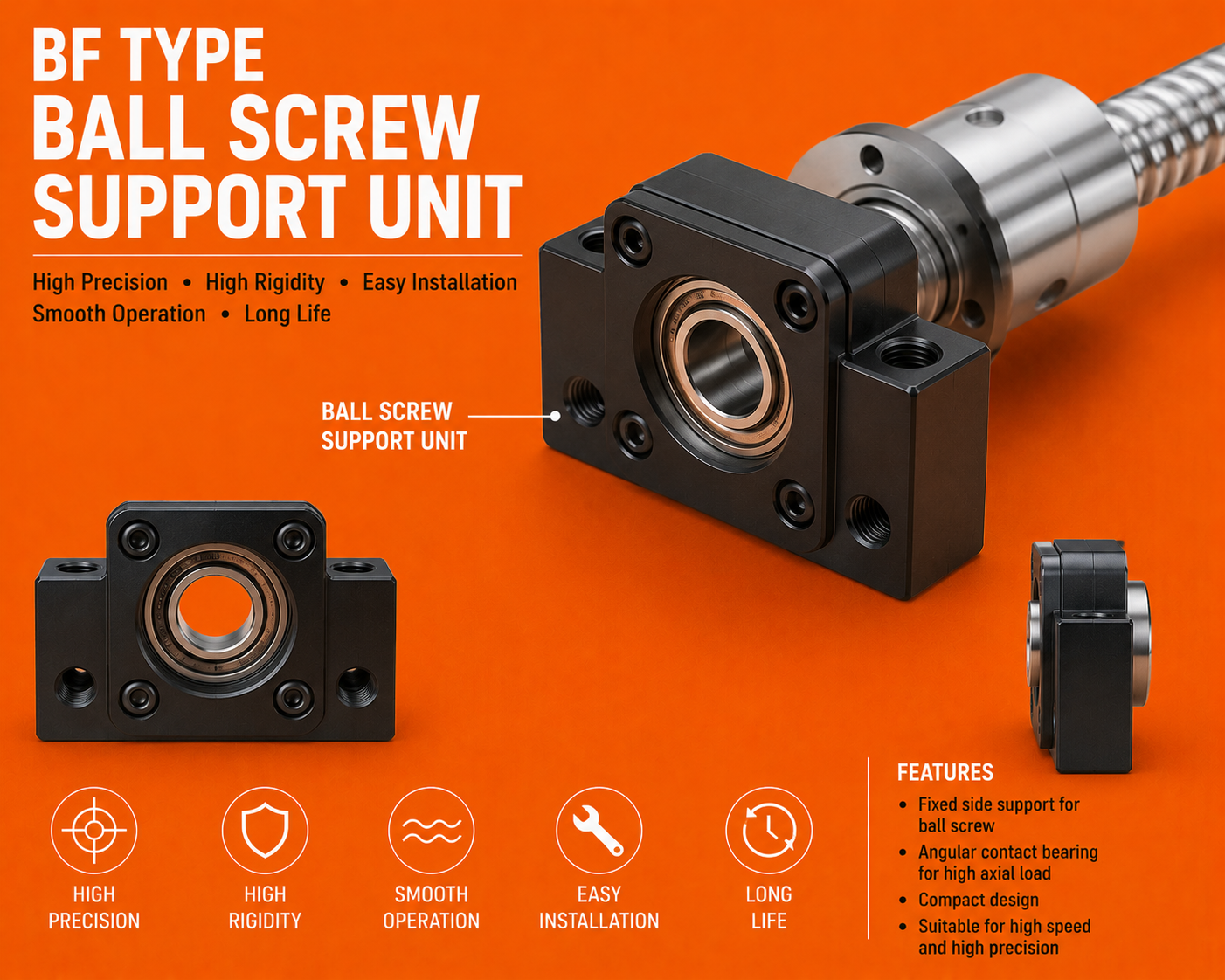 | Bf Type Ball Screw Support Unit Bf Type Ball Screw Support Unit Balaji Engineering Works offers high-quality BF Type Ball Screw Support Units, designed to provide reliable support for the floating end of ball... View product → |
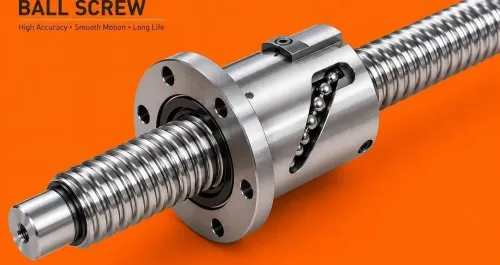
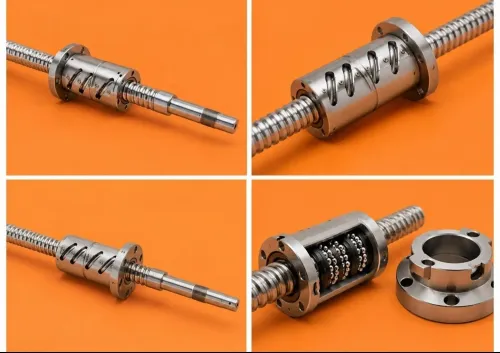
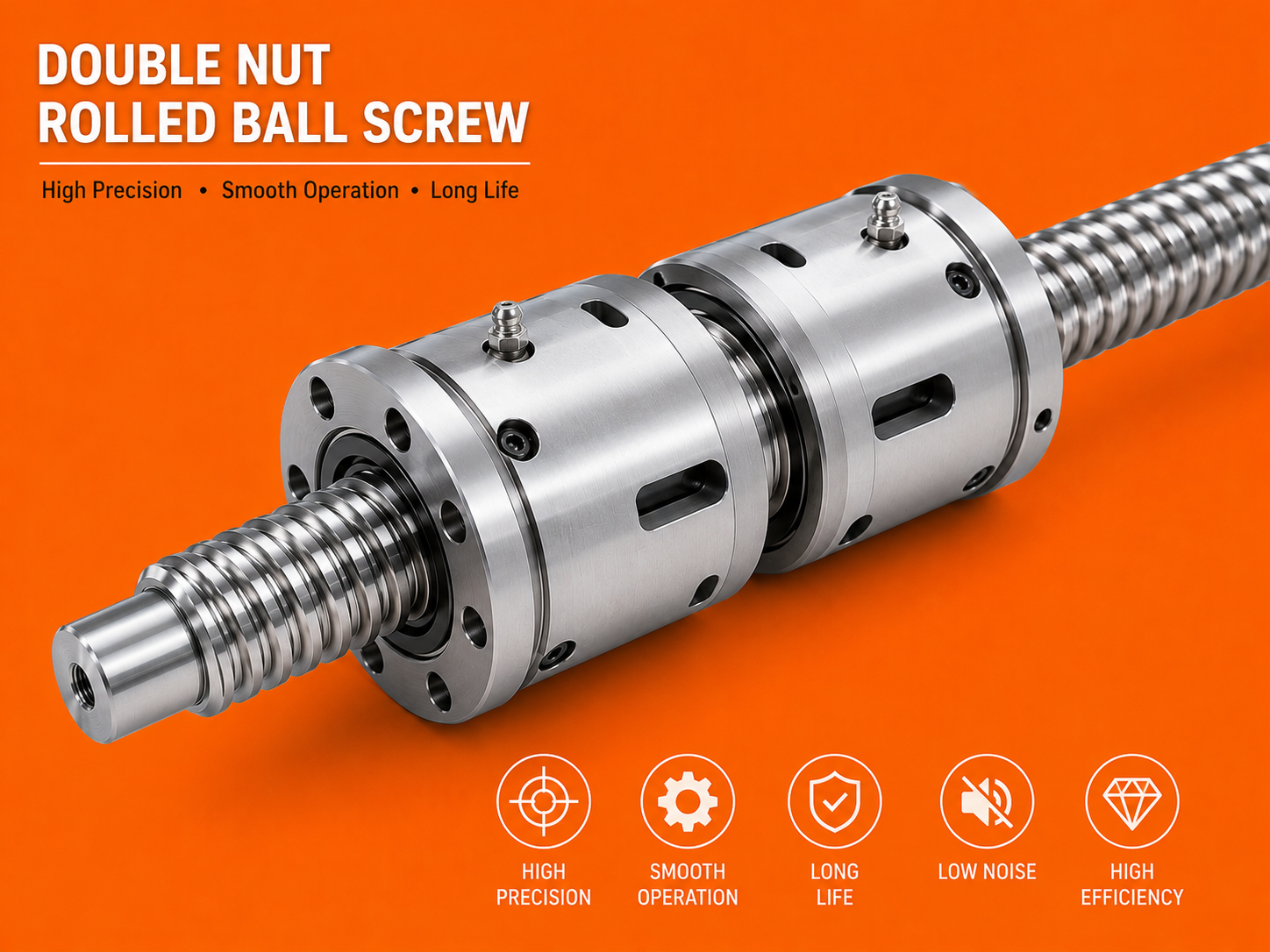 | Precision Ballscrews Balaji Engineering Works offers high-performance Double Nut Rolled Ball Screws in Pune, designed for applications requiring reduced backlash,... View product → |
Frequently asked questions
What does backlash look like in a ball screw axis?
The motor or screw reverses direction while the nut and machine slide remain stationary for a measurable distance. The dead zone repeats when you reverse travel.
How do you measure ball screw reversal play with an indicator?
Fix a dial indicator to the machine base, place its tip against the moving slide, command small reversals, and record the indicator movement before the slide responds. Repeat the test several times from both directions.
How can you separate nut backlash from other axis errors?
Check the coupling, screw supports, guideways, mounting bolts, and slide movement before condemning the nut. A loose coupling or support bearing can produce the same reversal signature.
What should you inspect in the BF floating-end support?
Check bearing looseness, axial movement, preload, retaining hardware, contamination, and damage. Confirm that the support is floating as designed rather than allowing uncontrolled axial play.