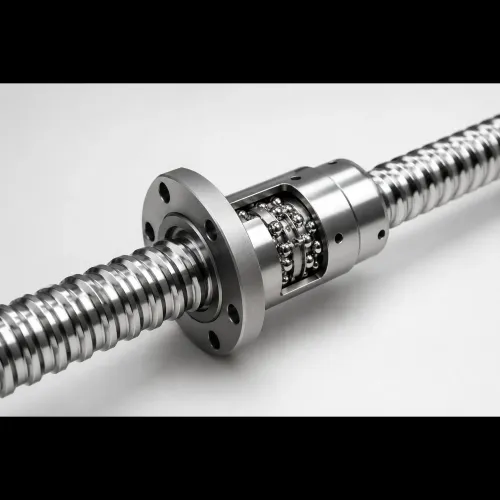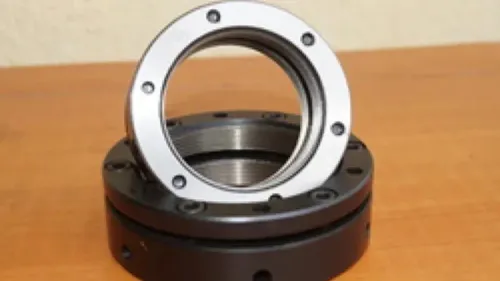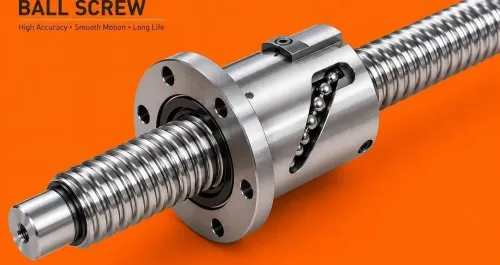

“Stainless steel” does not identify the alloy, hardness, or material of every load-bearing part in a ballscrew. By the end, you will be able to match the grade and construction to Pune’s coolant, washdown, humidity, and contamination conditions, then compare suppliers using measurable specifications rather than catalogue labels.
Key takeaways
- Choose hardened 440C for loaded raceways requiring wear and corrosion resistance.
- Match corrosion protection to coolant, humidity, chemicals, and cleaning exposure.
- Specify load, speed, lead, accuracy, preload, and travel before requesting quotes.
- Compare ground and rolled screws, then verify material, inspection, and runout records.
Which Stainless Steel Grade Belongs in a Precision Ballscrew?
Choose 440C for heavily loaded raceways when corrosion resistance must coexist with wear resistance. It is commonly hardened to about 58–62 HRC, giving balls and raceways a practical balance of hardness, fatigue resistance, and corrosion protection.
| Grade | Contact behavior | Suitable use |
|---|---|---|
| 304 | Strong general corrosion resistance, substantially softer | Covers, brackets, and lightly loaded parts |
| 316 | Better chloride resistance than 440C, but softer | Chloride-rich exposure when the design accepts lower contact performance |
| 440C | Hardenable to about 58–62 HRC | Balls and raceways under demanding loads |
| Another hardened alloy | Requires validated hardness and corrosion data | Special environments or surface-treatment designs |
Do not substitute 304 or 316 for hardened raceway material without recalculating load capacity, wear life, friction, and fatigue life. A 316 raceway can resist chloride exposure better than 440C, yet its lower hardness can shorten service life in a high-duty axis.
Grade choice trades corrosion resistance against hardness, manufacturability, and service life; it does not prove stiffness, dimensional stability, or load rating.
For a precision ballscrew manufacturer in Pune, stainless steel selection must cover each component separately:
- Screw shaft and nut raceway: request grade, heat treatment, and hardness.
- Balls and return system: confirm whether they are stainless or carbon steel.
- Seals, wipers, and end-support hardware: specify materials for the cleaning environment.
For a stainless steel precision ballscrew in Pune, remember that a stainless shaft with carbon-steel balls is not a fully stainless load path. A coating or alternate hardened alloy belongs in the design only after the supplier provides contact, corrosion, and life data.
How Much Corrosion Resistance Does Your Pune Application Need?
The required corrosion resistance is the resistance your actual fluid, spray and cleaning cycle demands, not an unqualified claim. A corrosion resistant ball screw in Pune needs an environment record before you choose its construction.
1. Record every exposure: water-based coolant, cutting oil, washdown water, high humidity, salt, chloride-bearing cleaner, acidic or alkaline chemical, and abrasive mist. State the fluid pH, temperature, spray pressure, spray distance, exposure frequency, and drying time.
2. Match the material to that record. 440C resists atmospheric moisture and ordinary washdown, but chloride water, salt spray and aggressive cleaners can still cause pitting. 316 suits chloride-rich surroundings better, yet its lower hardness can make it the wrong raceway material under high load or continuous duty.
3. Specify protection as part of the assembly. Select suitable wipers or seals, bellows or covers, drainage, compatible grease or oil, and a defined cleaning procedure. Ask a stainless steel ball screw supplier in Pune whether its washdown rating covers the shaft, nut, seals, or complete assembly, and request the fluid and pressure limits.
4. Treat abrasive contamination separately from corrosion. Coolant mist carrying chips or grit can damage raceways and recirculation paths without leaving visible rust. Inspect and clean the assembly at the stated interval, because corrosion resistance alone does not establish load life, wear life, or operating life.
Which Performance Data Must Be Sized Before You Order?
Size the screw from the complete motion profile, not nominal diameter and rpm. Provide these inputs before requesting a quotation:
- Shaft diameter, root diameter, lead, usable travel, and end-support arrangement
- Axial load in both directions, maximum speed, continuous speed, acceleration, stroke rate, and duty cycle
- Mounting orientation, required service life, nut style, preload, and required positioning or repeatability
- Coolant, washdown, chemical, abrasive, and humidity exposure
Check critical speed from unsupported length, root diameter, support configuration, shaft straightness, and the manufacturer’s calculation. Diameter and rpm alone are unsafe inputs. Check column buckling as well, especially on long or vertical axes carrying compressive load.
Use dynamic load rating and calculated L10 life separately from static capacity. The common relationship is approximately L10 proportional to (C/P)3 in revolutions; shock, contamination, poor lubrication, and misalignment can reduce the result substantially.
Preload removes axial play and raises stiffness, but it also increases friction, drive torque, heat, and contamination sensitivity.
| Nut choice | Benefit | Trade-off |
|---|---|---|
| Single nut | Compact, lower friction, lower starting torque | Limited rigidity and backlash control |
| Double nut | Higher rigidity and controlled preload | More length, heat, friction, and cost |
Preload cannot remove lead error, local lead variation, straightness error, bearing runout, or thermal growth. During precision ballscrew sourcing in Pune, ask for the manufacturer’s calculation and inspection data.
For a stainless steel precision ballscrew in Pune, verify each loaded component’s material and heat treatment rather than accepting a stainless shaft as proof of complete stainless construction.
When Do Ground, Rolled, Single-Nut, and Double-Nut Designs Differ?
Choose the manufacturing method and nut arrangement from required lead accuracy, repeatability, rigidity, and cost—not from “ground” or “rolled” alone.
| Method or arrangement | What it means | When it applies |
|---|---|---|
| Precision-ground | Machined after hardening; tighter lead control, finer surface finish, and more consistent geometry, with higher cost and stronger inspection demands | High positioning accuracy, repeatability, and rigidity |
| Rolled | Thread formed by rolling; economical for long travel and standard duty, but accuracy depends on the specified class and inspection | Moderate positioning requirements and cost-sensitive designs |
| Single-nut | Compact, lower friction, and lower starting torque; preload removes axial clearance | Space-limited axes where rigidity requirements permit |
| Double-nut | Controlled preload and higher rigidity, at the cost of length, friction, heat, and price | Demanding stiffness and backlash control justify the penalties |
Request ISO 3408 or JIS B 1192 accuracy class, effective travel, mean travel deviation, local lead variation, measurement method, temperature, and inspection conditions. A precision-ground screw is not automatically more accurate than every rolled screw; demand the evidence.
Preload cannot remove cumulative lead error, local lead variation, shaft straightness, bearing runout, or thermal growth. Confirm whether preload uses a spacer, offset, or oversized balls, and check starting torque and heat at operating speed.
A precision ballscrew manufacturer in Pune handling stainless steel, or a stainless steel ball screw supplier in Pune, should state these results for the complete assembly. Choose the arrangement that meets the error budget without buying unnecessary preload.
How Should You Verify a Pune Manufacturer or Supplier?
A documented purchase specification separates a precision ballscrew manufacturer in Pune stainless steel offering from a trader that only relabels an imported assembly. Ask who performs grinding, rolling, nut assembly, preload setting, and final inspection, and identify every subcontracted operation.
| Supplier type | Evidence to verify | Warning sign |
|---|---|---|
| Manufacturer | Process records, calibration records, traceability, and inspection reports tied to the shaft and nut | “Manufacturer” appears only on the quotation |
| Trading source | Original maker, certificates, and inspection responsibility are disclosed | No access to the actual process or batch records |
Request these documents for each quoted assembly:
- Material certificates for the shaft, nut, balls, return system, seals, and support hardware; compare the offered alloy and heat treatment rather than the product name.
- Heat-treatment records and hardness results for loaded contact components.
- Dimensional inspection, shaft runout, and lead-accuracy results across the complete usable stroke, with ISO 3408 or JIS B 1192 class and measurement conditions.
- Preload or starting-torque data, plus the stated basis for corrosion resistance, including fluid, pH, temperature, pressure, spray distance, and exposure frequency.
- EN 10204 3.1 certification when material traceability is contractually important.
Balaji Engineering Works can be evaluated on these same evidence points when you seek a stainless steel ball screw supplier in Pune. Put shaft diameter, lead, travel, accuracy class, preload, axial loads, speeds, duty cycle, environment, seals, supports, and inspection documents on the quotation. Require traceability from shaft and nut to the inspection report.
This makes precision ballscrew sourcing in Pune verifiable instead of dependent on “high precision,” “washdown,” or “corrosion resistant” wording.
Related product
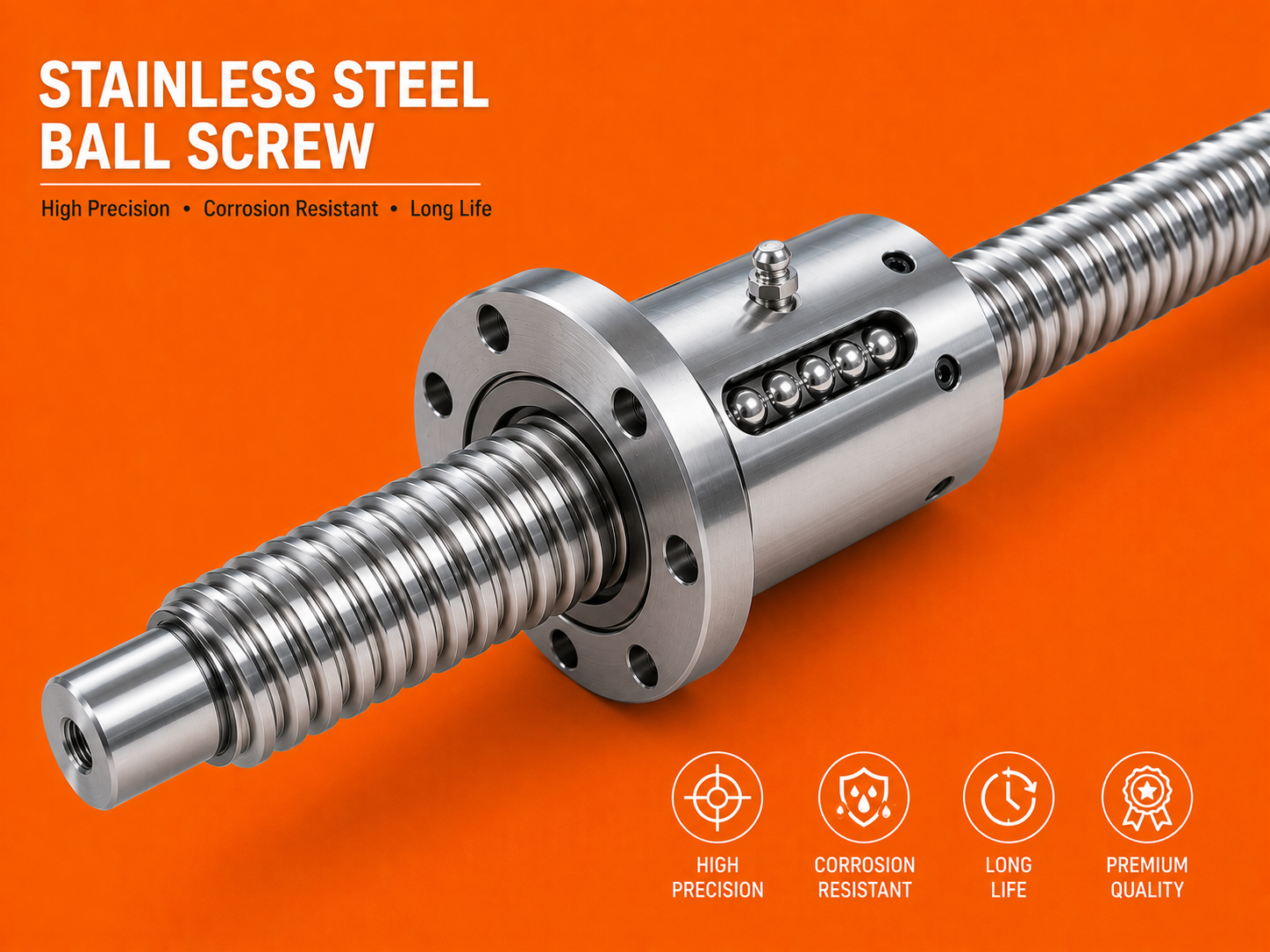 | Precision Ballscrews Balaji Engineering Works offers high-quality Stainless Steel Ball Screws in Pune, designed for precision linear motion with excellent corrosion... View product → |
Frequently asked questions
Which stainless steel grade belongs in a precision ballscrew?
Choose hardened 440C for heavily loaded raceways where wear resistance and corrosion protection must coexist. Its practical hardness range is about 58–62 HRC.
How much corrosion resistance does a Pune application need?
Assess direct exposure to water-based coolant, humidity, cleaning chemicals, chlorides, and washdown before selecting the steel grade and sealing arrangement.
Which performance data must be sized before ordering?
Provide axial load, travel length, speed, acceleration, duty cycle, lead, accuracy class, mounting arrangement, preload, and required service life.
When do ground, rolled, single-nut, and double-nut designs differ?
Ground screws suit demanding accuracy, rolled screws suit efficient production and longer lengths, single nuts reduce space, and double nuts improve preload control and stiffness.
How should you verify a Pune manufacturer or supplier?
Request material and heat-treatment records, dimensional and runout inspection results, preload details, accuracy data, traceability, and a drawing matched to your application.